while researching machines and how they work, tika finds several online sites that discuss how force and…
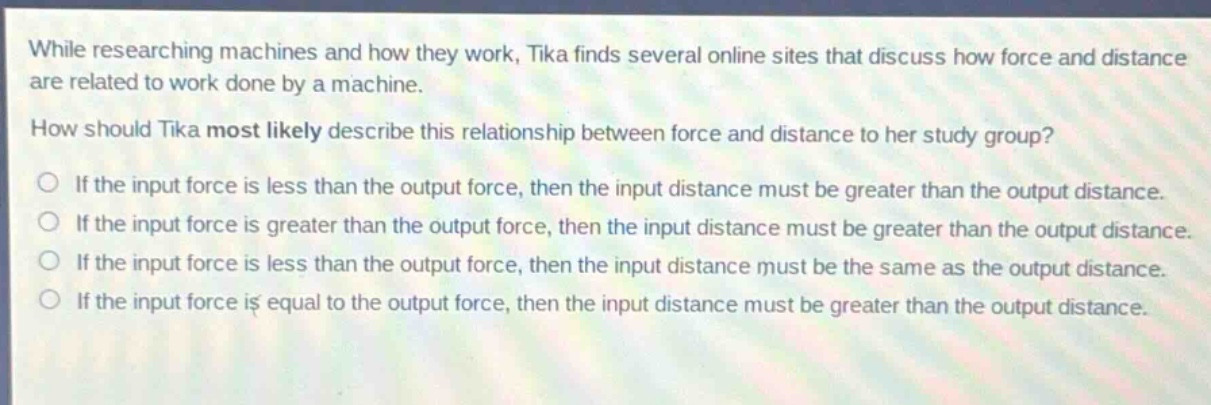
while researching machines and how they work, tika finds several online sites that discuss how force and distance are related to work done by a machine. how should tika most likely describe this relationship between force and distance to her study group? if the input force is less than the output force, then the input distance must be greater than the output distance. if the input force is greater than the output force, then the input distance must be greater than the output distance. if the input force is less than the output force, then the input distance must be the same as the output distance. if the input force is equal to the output force, then the input distance must be greater than the output distance.
Answer
Brief Explanations:
In machines, work input equals work output (neglecting friction). Work is calculated as force times distance ($W = F\times d$). If input force ($F_{in}$) is less than output force ($F_{out}$), to keep $F_{in}\times d_{in}=F_{out}\times d_{out}$, input distance ($d_{in}$) must be greater than output distance ($d_{out}$).
Answer:
If the input force is less than the output force, then the input distance must be greater than the output distance.