how does the work needed to lift an object and the gravitational potential energy of the object…
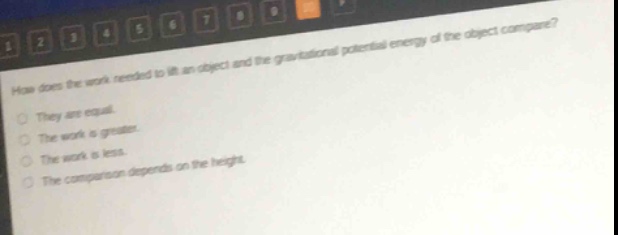
how does the work needed to lift an object and the gravitational potential energy of the object compare?\nthey are equal.\nthe work is greater.\nthe work is less.\nthe comparison depends on the height.
Answer
Explanation:
Step1: Recall work - energy theorem
The work - energy theorem states that the work done on an object to lift it is equal to the change in its gravitational potential energy. When we lift an object of mass $m$ through a height $h$ near the surface of the Earth (where the gravitational acceleration is $g$), the work done $W$ against gravity is given by $W = F\times d$, where the force $F = mg$ (weight of the object) and the distance $d=h$. The gravitational potential energy of the object at height $h$ relative to the initial position is $U = mgh$.
Step2: Compare work and potential energy
Since $W = mgh$ and $U=mgh$, the work required to lift an object is equal to the gravitational potential energy of the object.
Answer:
They are equal.