during a workout, a football player pushes a blocking dummy a distance of 30 m. while pushing the dummy the…
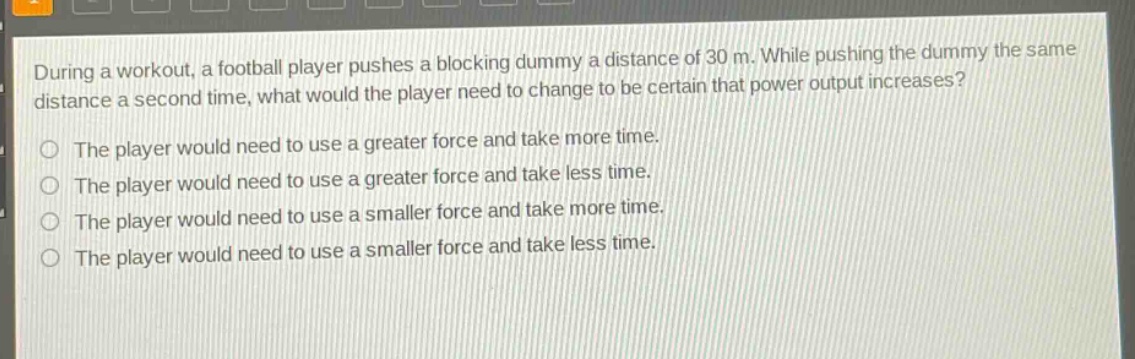
during a workout, a football player pushes a blocking dummy a distance of 30 m. while pushing the dummy the same distance a second time, what would the player need to change to be certain that power output increases? the player would need to use a greater force and take more time. the player would need to use a greater force and take less time. the player would need to use a smaller force and take more time. the player would need to use a smaller force and take less time.
Answer
Brief Explanations:
Power is defined as work done per unit time ($P=\frac{W}{t}$), and work is force times distance ($W = F\times d$). Given the distance $d$ is constant. To increase power, either increase work (by increasing force $F$) or decrease time $t$. So, a greater force and less time will increase power.
Answer:
The player would need to use a greater force and take less time.