xander reached a final velocity of 4.5 m/s in 3.5 seconds. finley reached a final velocity of 3.6 m/s in 4.2…
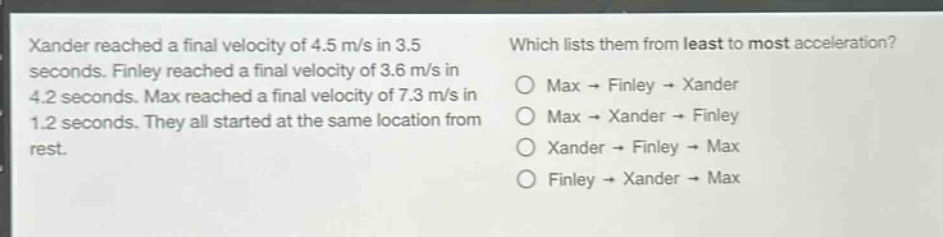
xander reached a final velocity of 4.5 m/s in 3.5 seconds. finley reached a final velocity of 3.6 m/s in 4.2 seconds. max reached a final velocity of 7.3 m/s in 1.2 seconds. they all started at the same location from rest. which lists them from least to most acceleration? max → finley → xander max → xander → finley xander → finley → max finley → xander → max
Answer
Explanation:
Step1: Recall acceleration formula
The formula for acceleration is $a=\frac{v - u}{t}$, where $v$ is final - velocity, $u$ is initial velocity, and $t$ is time. Since they start from rest, $u = 0\ m/s$, so $a=\frac{v}{t}$.
Step2: Calculate Xander's acceleration
For Xander, $v = 4.5\ m/s$ and $t = 3.5\ s$. Then $a_{Xander}=\frac{4.5}{3.5}\approx1.29\ m/s^{2}$.
Step3: Calculate Finley's acceleration
For Finley, $v = 3.6\ m/s$ and $t = 4.2\ s$. Then $a_{Finley}=\frac{3.6}{4.2}\approx0.86\ m/s^{2}$.
Step4: Calculate Max's acceleration
For Max, $v = 7.3\ m/s$ and $t = 1.2\ s$. Then $a_{Max}=\frac{7.3}{1.2}\approx6.08\ m/s^{2}$.
Step5: Compare accelerations
Comparing the values: $a_{Finley}<a_{Xander}<a_{Max}$.
Answer:
Finley → Xander → Max