y1 - lt 1 - 5; y2\nac motors quiz #1a\ntotal = _/16\nname: khador\n1. 3 what are the 3 main constructional…
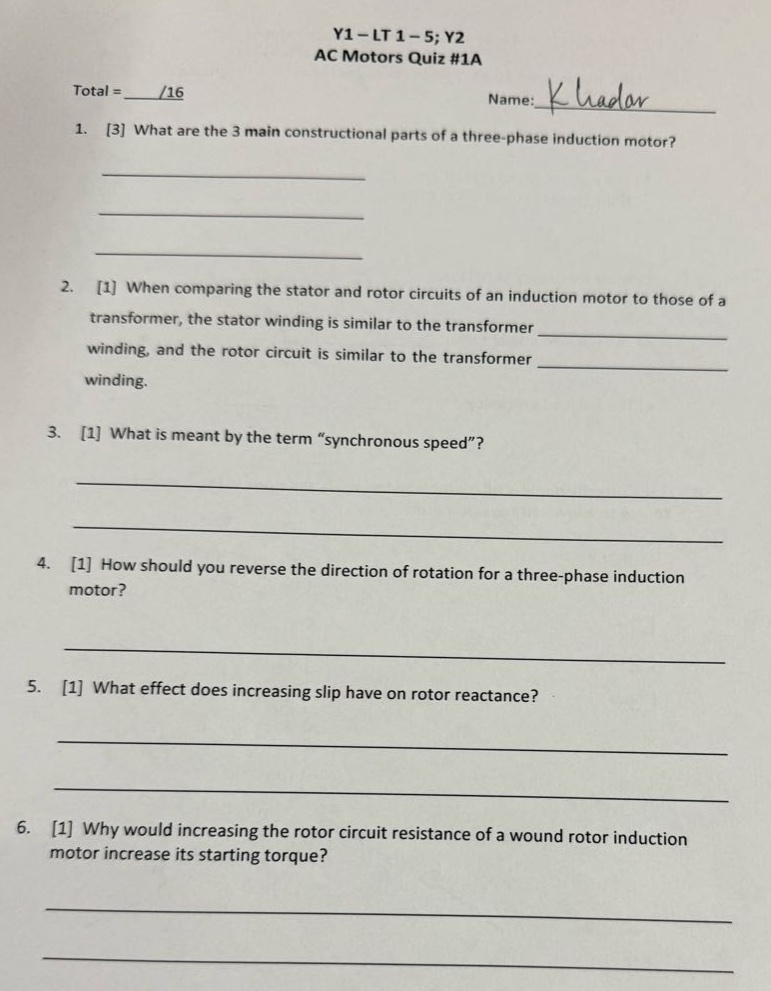
y1 - lt 1 - 5; y2\nac motors quiz #1a\ntotal = _/16\nname: khador\n1. 3 what are the 3 main constructional parts of a three - phase induction motor?\n2. 1 when comparing the stator and rotor circuits of an induction motor to those of a transformer, the stator winding is similar to the transformer _ winding, and the rotor circuit is similar to the transformer _ winding.\n3. 1 what is meant by the term “synchronous speed”?\n4. 1 how should you reverse the direction of rotation for a three - phase induction motor?\n5. 1 what effect does increasing slip have on rotor reactance?\n6. 1 why would increasing the rotor circuit resistance of a wound rotor induction motor increase its starting torque?
Answer
Brief Explanations:
- The three main constructional parts of a three - phase induction motor are the stator, rotor, and air - gap. The stator provides the magnetic field, the rotor is the rotating part, and the air - gap separates them.
- When comparing to a transformer, the stator winding is similar to the primary winding (which receives the input voltage), and the rotor circuit is similar to the secondary winding (which delivers the output).
- Synchronous speed is the speed at which the rotating magnetic field in an AC machine rotates. It is given by $n_s=\frac{120f}{P}$, where $f$ is the frequency of the supply and $P$ is the number of poles.
- To reverse the direction of rotation of a three - phase induction motor, any two of the three - phase supply lines are interchanged. This changes the phase sequence of the supply, which in turn changes the direction of the rotating magnetic field.
- Increasing slip increases the rotor reactance. As slip $s=\frac{n_s - n}{n_s}$, and rotor reactance $X_r = sX_{r0}$ (where $X_{r0}$ is the rotor reactance at standstill). So as $s$ increases, $X_r$ increases.
- Increasing the rotor circuit resistance of a wound - rotor induction motor increases its starting torque because it shifts the maximum torque point to a higher slip value. At starting (when slip $s = 1$), a higher resistance allows more current to flow in the rotor circuit in phase with the induced emf, thus increasing the starting torque.
Answer:
- Stator, Rotor, Air - gap
- Primary, Secondary
- The speed at which the rotating magnetic field in an AC machine rotates ($n_s=\frac{120f}{P}$)
- Interchange any two of the three - phase supply lines
- Increases rotor reactance
- Shifts the maximum torque point to a higher slip value and allows more in - phase current in the rotor circuit at starting