a yellow ball with a mass of 2 kg is rolling across the floor at 3 m/s. a red ball with a mass of 3 kg is…
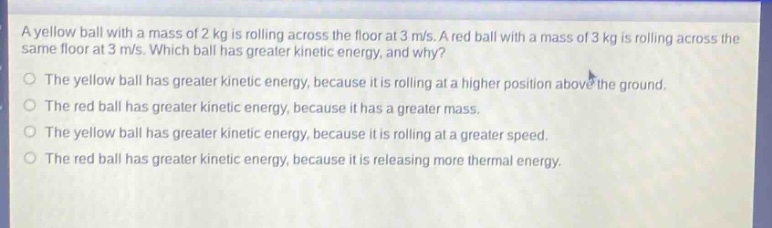
a yellow ball with a mass of 2 kg is rolling across the floor at 3 m/s. a red ball with a mass of 3 kg is rolling across the same floor at 3 m/s. which ball has greater kinetic energy, and why?\nthe yellow ball has greater kinetic energy, because it is rolling at a higher position above the ground.\nthe red ball has greater kinetic energy, because it has a greater mass.\nthe yellow ball has greater kinetic energy, because it is rolling at a greater speed.\nthe red ball has greater kinetic energy, because it is releasing more thermal energy.
Answer
Explanation:
Step1: Recall kinetic - energy formula
The formula for kinetic energy is $K = \frac{1}{2}mv^{2}$, where $m$ is the mass and $v$ is the velocity.
Step2: Calculate kinetic energy of yellow ball
For the yellow ball, $m_y=2\ kg$ and $v_y = 3\ m/s$. So $K_y=\frac{1}{2}\times2\times3^{2}=\frac{1}{2}\times2\times9 = 9\ J$.
Step3: Calculate kinetic energy of red ball
For the red ball, $m_r = 3\ kg$ and $v_r=3\ m/s$. So $K_r=\frac{1}{2}\times3\times3^{2}=\frac{1}{2}\times3\times9=\frac{27}{2}=13.5\ J$.
Step4: Compare kinetic energies
Since $K_r = 13.5\ J$ and $K_y=9\ J$, and $13.5>9$, the red ball has greater kinetic energy because it has a greater mass while the speeds are the same.
Answer:
The red ball has greater kinetic energy, because it has a greater mass.