yoon ki investigates electromagnetic induction by moving a bar magnet into a coil of wire. his experimental…
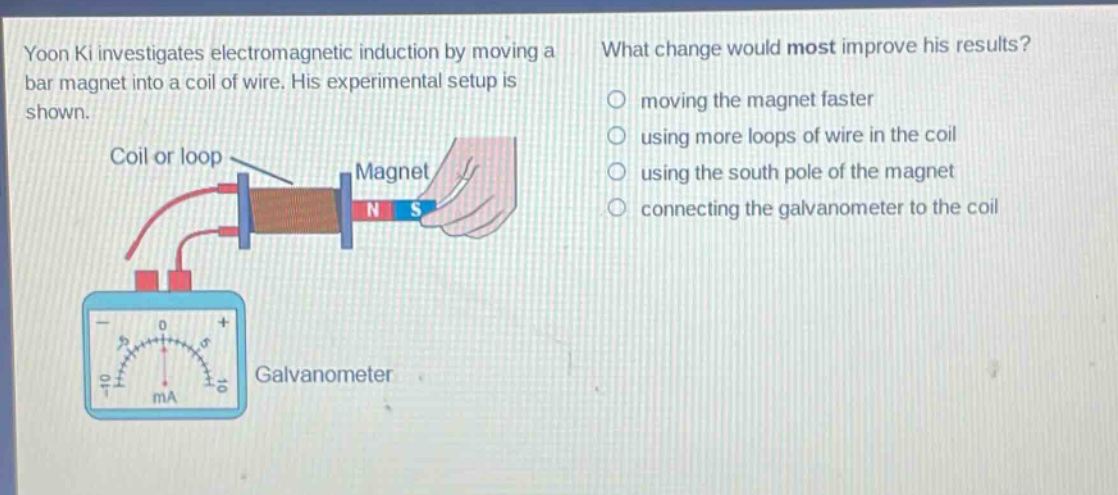
yoon ki investigates electromagnetic induction by moving a bar magnet into a coil of wire. his experimental setup is shown. what change would most improve his results? moving the magnet faster using more loops of wire in the coil using the south pole of the magnet connecting the galvanometer to the coil coil or loop magnet galvanometer
Answer
Explanation:
Step1: Recall Faraday's law
The induced - emf ($\epsilon$) in a coil is given by $\epsilon=-N\frac{\Delta\Phi}{\Delta t}$, where $N$ is the number of turns in the coil and $\frac{\Delta\Phi}{\Delta t}$ is the rate of change of magnetic flux.
Step2: Analyze each option
- Moving the magnet faster increases $\frac{\Delta\Phi}{\Delta t}$, but using more loops ($N$) has a more significant impact as it is a multiplicative factor in the formula.
- Using the south - pole of the magnet instead of the north - pole does not change the magnitude of the induced emf, only the direction of the induced current.
- The galvanometer is already connected to the coil as shown in the setup.
- Increasing the number of loops ($N$) in the coil will increase the induced emf according to Faraday's law.
Answer:
using more loops of wire in the coil