you have a 100 ohm resistor. how much resistance must you add in parallel to the 100 ohm resistor to create…
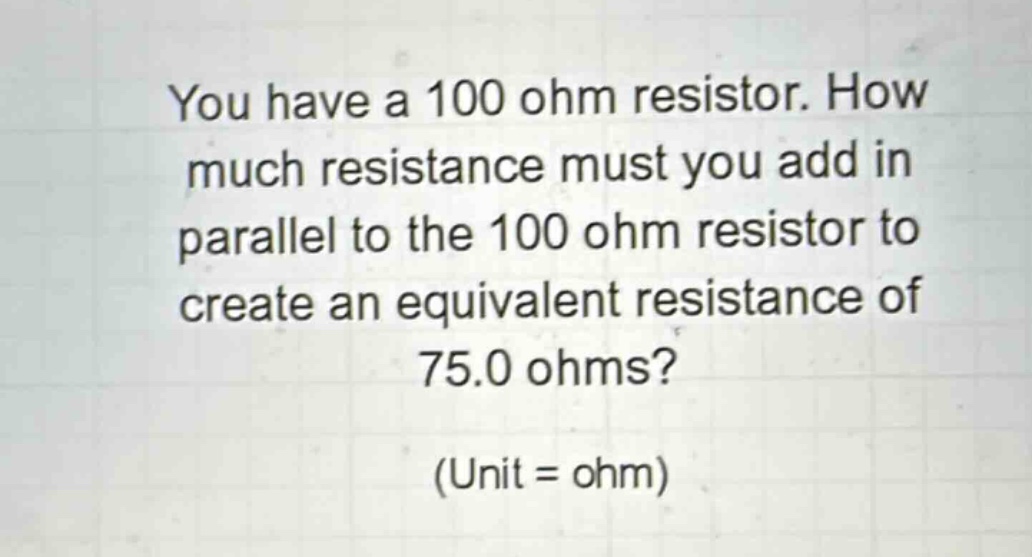
you have a 100 ohm resistor. how much resistance must you add in parallel to the 100 ohm resistor to create an equivalent resistance of 75.0 ohms? (unit = ohm)
Answer
Explanation:
Step1: Recall parallel - resistance formula
The formula for resistors in parallel is $\frac{1}{R_{eq}}=\frac{1}{R_1}+\frac{1}{R_2}$, where $R_{eq}$ is the equivalent resistance, $R_1$ and $R_2$ are the individual resistances. We know that $R_1 = 100\ \Omega$ and $R_{eq}=75\ \Omega$.
Step2: Substitute values into the formula
Substitute the known values into $\frac{1}{R_{eq}}=\frac{1}{R_1}+\frac{1}{R_2}$: $\frac{1}{75}=\frac{1}{100}+\frac{1}{R_2}$.
Step3: Solve for $\frac{1}{R_2}$
$\frac{1}{R_2}=\frac{1}{75}-\frac{1}{100}$. Find a common - denominator, which is 300. Then $\frac{1}{75}-\frac{1}{100}=\frac{4}{300}-\frac{3}{300}=\frac{4 - 3}{300}=\frac{1}{300}$.
Step4: Find $R_2$
Since $\frac{1}{R_2}=\frac{1}{300}$, then $R_2 = 300\ \Omega$.
Answer:
300