3. if you have a broken wrist, what nuclear medical treatment are you most likely to receive?\nx…
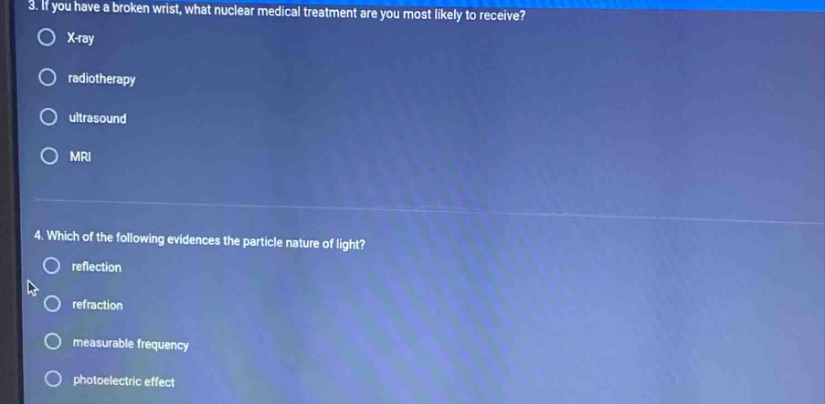
3. if you have a broken wrist, what nuclear medical treatment are you most likely to receive?\nx - ray\nradiotherapy\nultrasound\nmri\n4. which of the following evidences the particle nature of light?\nreflection\nrefraction\nmeasurable frequency\ntphotoelectric effect
Answer
Brief Explanations:
Question 3:
X - ray is a common imaging method but not a nuclear medical treatment. Radiotherapy is mainly for cancer treatment. Ultrasound uses sound waves and MRI uses magnetic fields and radio waves. None of them are nuclear medical treatments. There is no correct nuclear medical treatment option here among the given ones, but if we consider the closest in the context of medical imaging for a broken wrist, X - ray is the most commonly used for initial diagnosis.
Question 4:
Reflection and refraction are wave - like properties of light. Measurable frequency is also a property related to the wave nature. The photoelectric effect shows that light can eject electrons from a metal surface, which is evidence of the particle nature of light as it implies light interacts with matter in discrete packets (photons).
Answer:
- None of the above (but X - ray is the most common imaging for broken wrist among these)
- photoelectric effect