you computed the specific heat for each of the four metals using the formula below: $c_{metal}=\frac{-c_{wate…
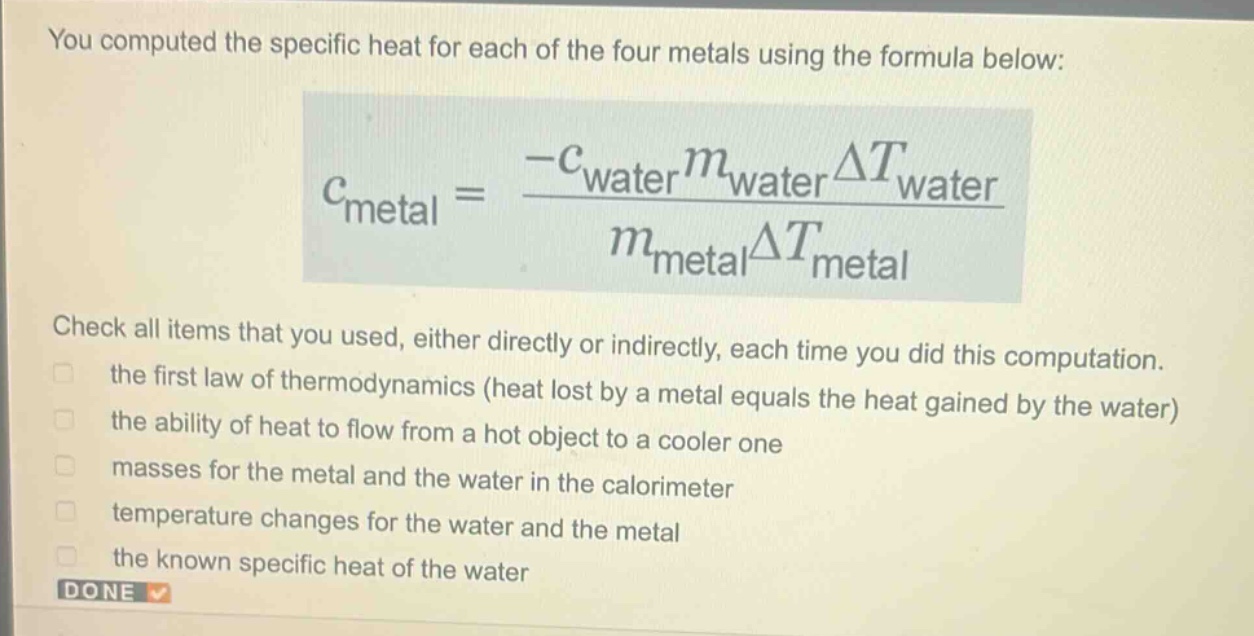
you computed the specific heat for each of the four metals using the formula below: $c_{metal}=\frac{-c_{water}m_{water}delta t_{water}}{m_{metal}delta t_{metal}}$ check all items that you used, either directly or indirectly, each time you did this computation. the first law of thermodynamics (heat lost by a metal equals the heat gained by the water) the ability of heat to flow from a hot object to a cooler one masses for the metal and the water in the calorimeter temperature changes for the water and the metal the known specific heat of the water done
Answer
Brief Explanations:
The formula $c_{\text{metal}} = \frac{-c_{\text{water}} m_{\text{water}} \Delta T_{\text{water}}}{m_{\text{metal}} \Delta T_{\text{metal}}}$ is derived from the principle of calorimetry. This principle assumes that in an isolated system, the heat lost by the hotter object (metal) is equal in magnitude to the heat gained by the cooler object (water). This is an application of the first law of thermodynamics (conservation of energy), stated as $q_{\text{metal}} + q_{\text{water}} = 0$, or $q_{\text{metal}} = -q_{\text{water}}$. The heat transfer itself relies on the fundamental principle that heat naturally flows from hotter to colder objects. The formula explicitly requires the values for the mass of the metal ($m_{\text{metal}}$), the mass of the water ($m_{\text{water}}$), the temperature change of the metal ($\Delta T_{\text{metal}}$), the temperature change of the water ($\Delta T_{\text{water}}$), and the known specific heat capacity of water ($c_{\text{water}}$). Therefore, all the listed items are necessary components or underlying principles for this computation.
Answer:
- the first law of thermodynamics (heat lost by a metal equals the heat gained by the water)
- the ability of heat to flow from a hot object to a cooler one
- masses for the metal and the water in the calorimeter
- temperature changes for the water and the metal
- the known specific heat of the water