you computed the specific heat for each of the four metals using the formula below: $c_{metal}=\frac{-c_{wate…
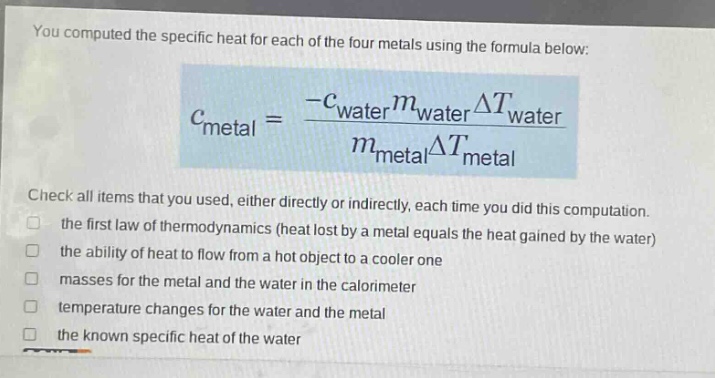
you computed the specific heat for each of the four metals using the formula below: $c_{metal}=\frac{-c_{water}m_{water}delta t_{water}}{m_{metal}delta t_{metal}}$ check all items that you used, either directly or indirectly, each time you did this computation. the first law of thermodynamics (heat lost by a metal equals the heat gained by the water) the ability of heat to flow from a hot object to a cooler one masses for the metal and the water in the calorimeter temperature changes for the water and the metal the known specific heat of the water
Answer
Brief Explanations:
- The formula for specific - heat of metal is derived from the first law of thermodynamics (heat lost by metal = heat gained by water), so this is used.
- The heat - flow principle (heat flows from hot to cold) is the basis for the heat - transfer process in the calorimeter, so it is used.
- The masses of metal and water ($m_{metal}$ and $m_{water}$) are directly part of the formula, so they are used.
- The temperature changes of water and metal ($\Delta T_{water}$ and $\Delta T_{metal}$) are also directly part of the formula, so they are used.
- The known specific heat of water ($c_{water}$) is in the numerator of the formula, so it is used.
Answer:
the first law of thermodynamics (heat lost by a metal equals the heat gained by the water), the ability of heat to flow from a hot object to a cooler one, masses for the metal and the water in the calorimeter, temperature changes for the water and the metal, the known specific heat of the water