you have learned about how particles in solids, liquids, and gases behave as thermal energy increases. click…
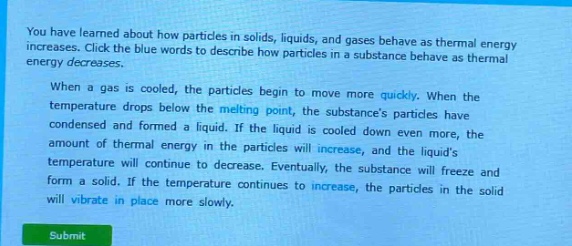
you have learned about how particles in solids, liquids, and gases behave as thermal energy increases. click the blue words to describe how particles in a substance behave as thermal energy decreases.\nwhen a gas is cooled, the particles begin to move more quickly. when the temperature drops below the melting point, the substances particles have condensed and formed a liquid. if the liquid is cooled down even more, the amount of thermal energy in the particles will increase, and the liquids temperature will continue to decrease. eventually, the substance will freeze and form a solid. if the temperature continues to increase, the particles in the solid will vibrate in place more slowly.
Answer
Brief Explanations:
The text contains multiple incorrect statements about particle behavior with temperature changes. When a gas is cooled, particles move more slowly, not more quickly. Condensation occurs when the temperature drops below the boiling - point (not melting - point) for a gas to turn into a liquid. When a liquid is cooled, the amount of thermal energy decreases, not increases. When the temperature of a solid increases, particles vibrate more quickly, not more slowly.
Answer:
All the blue - worded statements in the text are incorrect. When a gas is cooled, the particles begin to move more slowly. When the temperature drops below the boiling point, the substance's particles have condensed and formed a liquid. If the liquid is cooled down even more, the amount of thermal energy in the particles will decrease, and the liquid's temperature will continue to decrease. Eventually, the substance will freeze and form a solid. If the temperature continues to increase, the particles in the solid will vibrate more quickly.