1. in your own words, what is resonance? why does a system respond strongly at its resonant frequency?\n2…
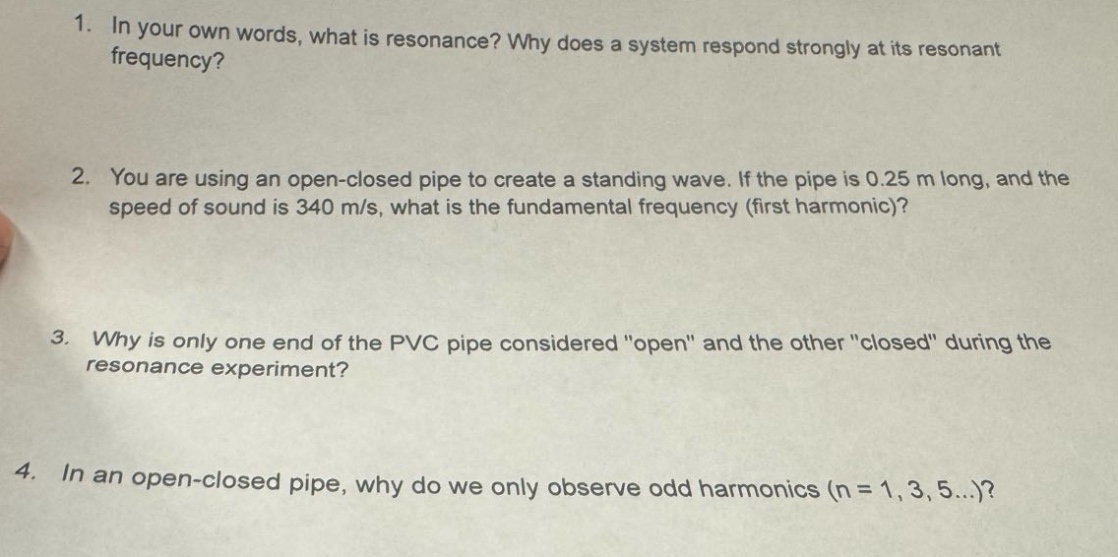
1. in your own words, what is resonance? why does a system respond strongly at its resonant frequency?\n2. you are using an open - closed pipe to create a standing wave. if the pipe is 0.25 m long, and the speed of sound is 340 m/s, what is the fundamental frequency (first harmonic)?\n3. why is only one end of the pvc pipe considered \open\ and the other \closed\ during the resonance experiment?\n4. in an open - closed pipe, why do we only observe odd harmonics (n = 1,3,5...)?
Answer
1.
Brief Explanations:
Resonance is when an external force's frequency matches a system's natural frequency, causing large - amplitude vibrations. At the resonant frequency, the energy transfer from the external source to the system is maximized as the system easily absorbs and stores energy, leading to a strong response.
Answer:
Resonance is when an external force's frequency matches a system's natural frequency, causing large - amplitude vibrations. A system responds strongly at its resonant frequency because energy transfer is maximized and the system easily absorbs and stores energy.
2.
Explanation:
Step1: Recall the formula for the fundamental frequency of an open - closed pipe
For an open - closed pipe, the fundamental wavelength $\lambda = 4L$, where $L$ is the length of the pipe.
Step2: Use the wave - speed formula $v = f\lambda$ to find the frequency
We know $v = 340$ m/s and $\lambda=4L$. Given $L = 0.25$ m, so $\lambda=4\times0.25=1$ m. From $v = f\lambda$, we can solve for $f$: $f=\frac{v}{\lambda}$. Substituting $v = 340$ m/s and $\lambda = 1$ m, we get $f=\frac{340}{1}=340$ Hz.
Answer:
340 Hz
3.
Brief Explanations:
One end is open because it is in contact with the surrounding air, allowing air particles to move freely in and out, creating an antinode of air - pressure variation. The other end is closed as the air particles cannot move freely at that end, creating a node of air - pressure variation.
Answer:
One end is in contact with the surrounding air allowing free movement of air particles (antinode), while the other end restricts air - particle movement (node).
4.
Brief Explanations:
In an open - closed pipe, the boundary conditions require a node at the closed end and an antinode at the open end. When we consider the standing - wave patterns and the relationship between wavelength and length of the pipe, only odd - numbered harmonics satisfy these boundary conditions. For even harmonics, the required wave patterns would violate the node - antinode boundary conditions at the ends of the pipe.
Answer:
The boundary conditions (node at closed end and antinode at open end) are only satisfied by odd - numbered harmonics. Even harmonics would violate these conditions.