10. base your answers to the following questions on the student investigation described below and on your…
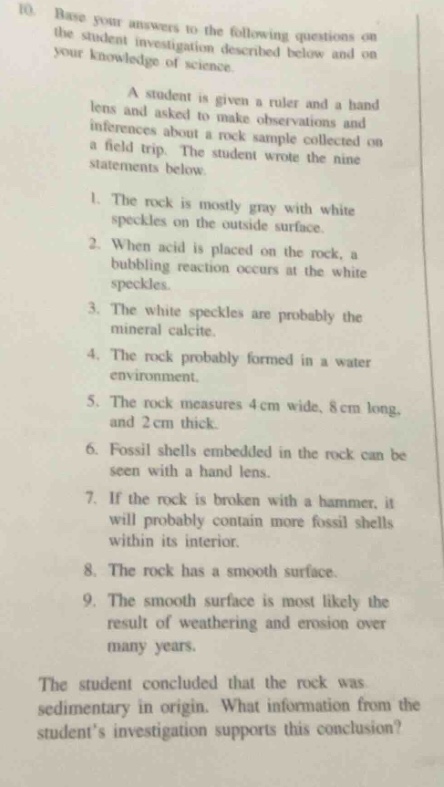
10. base your answers to the following questions on the student investigation described below and on your knowledge of science.\n\na student is given a ruler and a hand lens and asked to make observations and inferences about a rock sample collected on a field trip. the student wrote the nine statements below.\n1. the rock is mostly gray with white speckles on the outside surface.\n2. when acid is placed on the rock, a bubbling reaction occurs at the white speckles.\n3. the white speckles are probably the mineral calcite.\n4. the rock probably formed in a water environment.\n5. the rock measures 4 cm wide, 8 cm long, and 2 cm thick.\n6. fossil shells embedded in the rock can be seen with a hand lens.\n7. if the rock is broken with a hammer, it will probably contain more fossil shells within its interior.\n8. the rock has a smooth surface.\n9. the smooth surface is most likely the result of weathering and erosion over many years.\n\nthe student concluded that the rock was sedimentary in origin. what information from the students investigation supports this conclusion?
Answer
Brief Explanations:
Sedimentary rocks often form in water environments, contain fossils, and may have minerals that react with acid (like calcite). The student's statements that support the sedimentary origin include: the rock likely formed in a water environment, fossil shells are visible in it, it probably contains more fossil shells inside, and the white speckles (calcite, which reacts with acid) are present, as calcite is common in some sedimentary rocks.
Answer:
The following information supports the conclusion that the rock is sedimentary:
- Statement 4: The rock probably formed in a water environment (many sedimentary rocks form in aquatic settings).
- Statement 6: Fossil shells embedded in the rock can be seen with a hand lens (fossils are a common feature of sedimentary rocks).
- Statement 7: If the rock is broken with a hammer, it will probably contain more fossil shells within its interior (further indicates fossil-bearing nature typical of sedimentary rocks).
- Statement 3 and 2: The white speckles are probably calcite, which reacts with acid (calcite is abundant in sedimentary rocks like limestone).