38. how are the political systems of north korea and saudi arabia compare both similar and different?\n39…
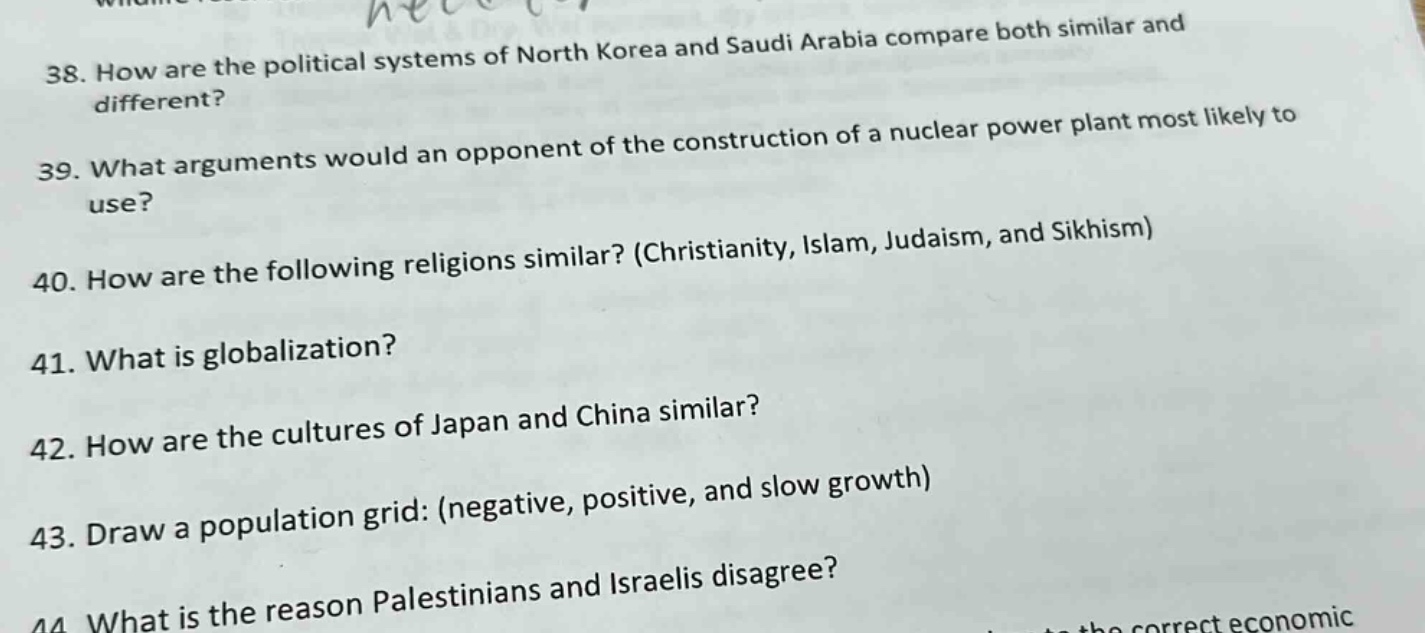
38. how are the political systems of north korea and saudi arabia compare both similar and different?\n39. what arguments would an opponent of the construction of a nuclear power plant most likely to use?\n40. how are the following religions similar? (christianity, islam, judaism, and sikhism)\n41. what is globalization?\n42. how are the cultures of japan and china similar?\n43. draw a population grid: (negative, positive, and slow growth)\n44. what is the reason palestinians and israelis disagree?
Answer
38.
Brief Explanations:
Both North Korea and Saudi Arabia have strong - centralizing features. North Korea is a socialist country with a people - centered political system where the power belongs to the people. Saudi Arabia is an absolute monarchy with the king having significant power. Differences lie in ideology (socialist vs. Islamic - based), and the way power is structured and exercised.
Answer:
Similarities: Both have centralized power structures. Differences: North Korea is socialist with people - centered power, while Saudi Arabia is an absolute monarchy with power centered around the king and an Islamic - based system.
39.
Brief Explanations:
An opponent might use arguments such as the risk of nuclear accidents (e.g., Chernobyl, Fukushima), long - term radioactive waste disposal problems, high construction and decommissioning costs, and the potential for nuclear proliferation if the technology or materials are misused.
Answer:
Risk of accidents, radioactive waste disposal, high costs, nuclear proliferation risks.
40.
Brief Explanations:
These religions are similar in that they are monotheistic (believe in one God), have sacred texts (Bible for Christianity, Quran for Islam, Torah for Judaism, Guru Granth Sahib for Sikhism), and have moral and ethical codes guiding the behavior of their followers.
Answer:
Monotheistic, have sacred texts, have moral/ethical codes.
41.
Brief Explanations:
Globalization refers to the increasing interconnectedness and interdependence of countries and people around the world through the exchange of goods, services, ideas, culture, and technology. It involves economic integration (e.g., free - trade agreements), cultural diffusion, and the spread of information and communication technologies.
Answer:
Increasing interconnectedness and interdependence of countries through exchange of goods, services, ideas, culture, and technology.
42.
Brief Explanations:
Japan and China have similar cultures in aspects like writing systems (Japanese kanji has roots in Chinese characters), Confucian values influencing social and family structures, and traditional art forms such as calligraphy and some forms of painting.
Answer:
Similar writing systems, influence of Confucian values, similar traditional art forms.
43.
Brief Explanations:
A population grid for negative, positive, and slow growth could be a table or a graphical representation. Rows could represent different regions or time - periods, and columns could be labeled as negative growth (where the population is decreasing), positive growth (where the population is increasing), and slow growth (a small rate of increase). For example, in a table, you could list countries in the first column and their population growth status in the other columns.
Answer:
Create a table or graph with columns labeled negative growth, positive growth, slow growth and rows for different regions or time - periods.
44.
Brief Explanations:
The main reasons for the disagreement between Palestinians and Israelis include territorial disputes (especially over the West Bank, Gaza Strip, and East Jerusalem), issues related to the right of return for Palestinian refugees, and religious and nationalistic differences.
Answer:
Territorial disputes, right of return of refugees, religious and nationalistic differences.