answer the questions based on the information given. the amur plate, a small plate, has moved away from the…
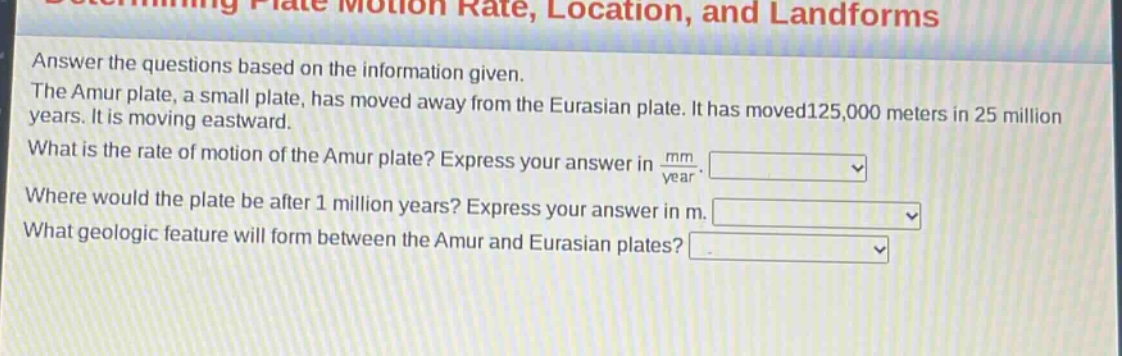
answer the questions based on the information given. the amur plate, a small plate, has moved away from the eurasian plate. it has moved125,000 meters in 25 million years. it is moving eastward. what is the rate of motion of the amur plate? express your answer in mm/year. where would the plate be after 1 million years? express your answer in m. what geologic feature will form between the amur and eurasian plates?
Answer
Explanation:
Step1: Convert meters to millimeters and years to find rate
125000 m = 125000000 mm, 25 million years = 25000000 years. Rate = $\frac{125000000}{25000000}$ = 5 mm/year.
Step2: Find distance in 1 million years
If rate is 5 mm/year, in 1 million years (1000000 years), distance in mm is 5×1000000 = 5000000 mm. Convert to meters: 5000000 mm = 5000 m.
Step3: Identify geologic feature
Since the Amur plate is moving away from the Eurasian plate (divergent - plate boundary), a rift valley will form.
Answer:
5 mm/year 5000 m Rift valley