a citys bus line is used more as the urban population density increases. the more people in an area, the…
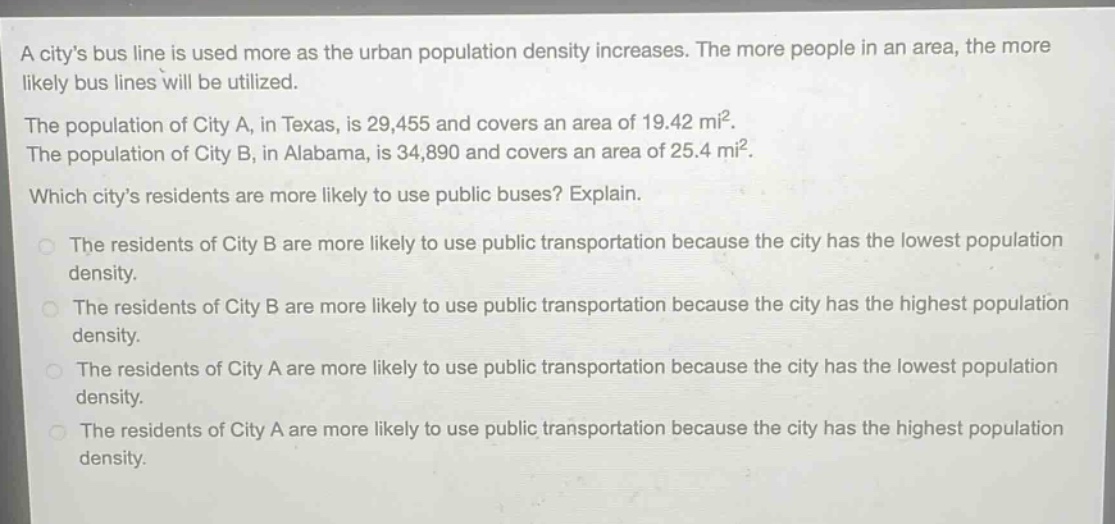
a citys bus line is used more as the urban population density increases. the more people in an area, the more likely bus lines will be utilized.\nthe population of city a, in texas, is 29,455 and covers an area of 19.42 mi².\nthe population of city b, in alabama, is 34,890 and covers an area of 25.4 mi².\nwhich citys residents are more likely to use public buses? explain.\nthe residents of city b are more likely to use public transportation because the city has the lowest population density.\nthe residents of city b are more likely to use public transportation because the city has the highest population density.\nthe residents of city a are more likely to use public transportation because the city has the lowest population density.\nthe residents of city a are more likely to use public transportation because the city has the highest population density.
Answer
Answer:
D. The residents of City A are more likely to use public transportation because the city has the highest population density.
Explanation:
Step1: Calculate population density of City A
Population density = $\frac{Population}{Area}$, so for City A, density = $\frac{29455}{19.42}\approx1517.76$ people per square - mile.
Step2: Calculate population density of City B
For City B, density = $\frac{34890}{25.4}\approx1373.62$ people per square - mile.
Step3: Compare population densities
Since $1517.76>1373.62$, City A has a higher population density. And as the problem states that more people in an area (higher population density) means more likely use of bus lines, City A's residents are more likely to use public buses.