a citys bus line is used more as the urban population density increases. the more people in an area, the…
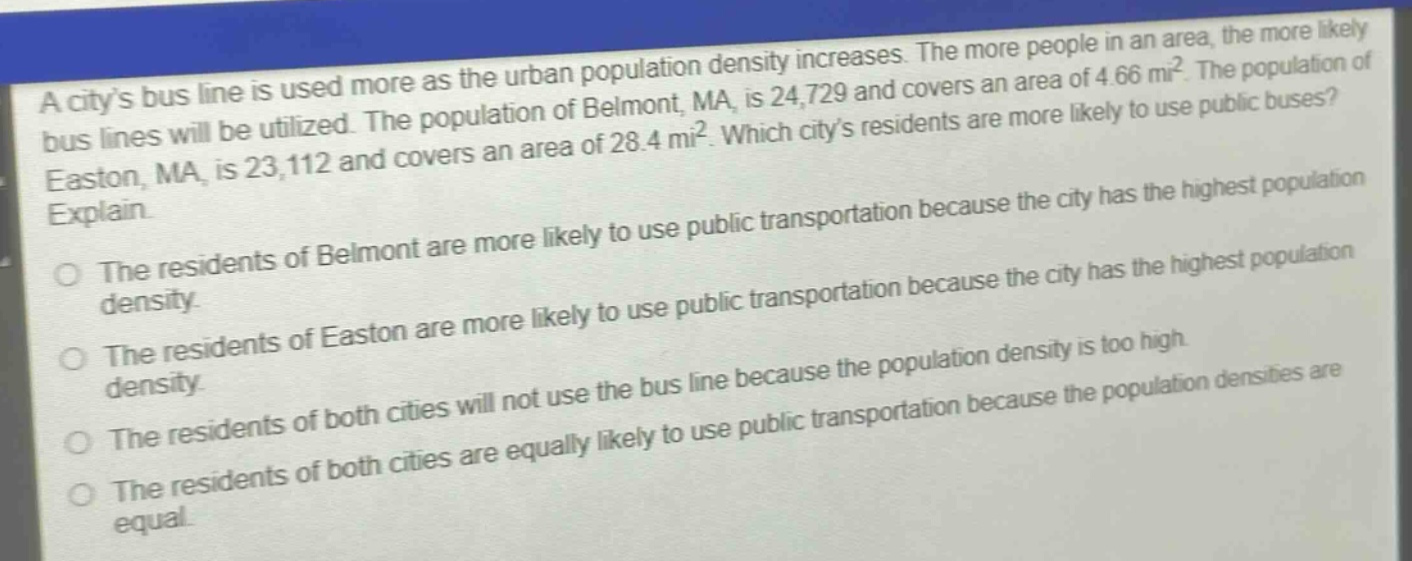
a citys bus line is used more as the urban population density increases. the more people in an area, the more likely bus lines will be utilized. the population of belmont, ma, is 24,729 and covers an area of 4.66 mi². the population of easton, ma, is 23,112 and covers an area of 28.4 mi². which citys residents are more likely to use public buses? explain.\nthe residents of belmont are more likely to use public transportation because the city has the highest population density.\nthe residents of easton are more likely to use public transportation because the city has the highest population density.\nthe residents of both cities will not use the bus line because the population density is too high.\nthe residents of both cities are equally likely to use public transportation because the population densities are equal.
Answer
Explanation:
Step1: Calculate Belmont's population density
Population density = $\frac{\text{Population}}{\text{Area}}$. For Belmont, population = 24729 and area = 4.66 mi². So, density of Belmont = $\frac{24729}{4.66}\approx5306.65$ people/mi².
Step2: Calculate Easton's population density
For Easton, population = 23112 and area = 28.4 mi². So, density of Easton = $\frac{23112}{28.4}\approx813.80$ people/mi².
Step3: Compare the population - densities
Since 5306.65 > 813.80, Belmont has a higher population density. And as the urban population density increases, the bus line is used more.
Answer:
The residents of Belmont are more likely to use public transportation because the city has the highest population density.