consider this claim: athletes who wear red are more likely to win competitions. which piece of evidence…
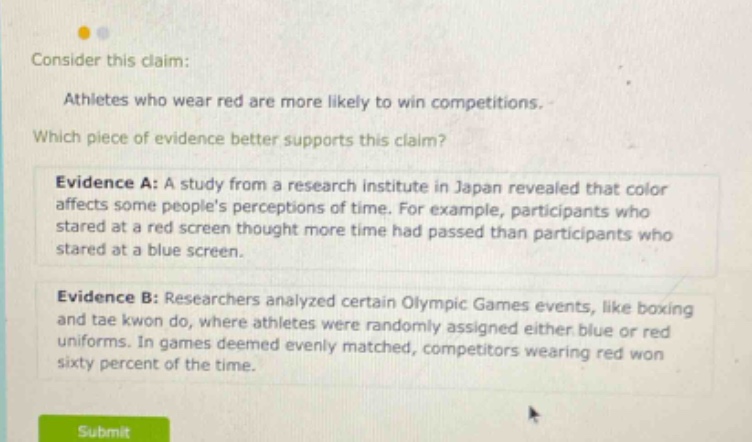
consider this claim: athletes who wear red are more likely to win competitions. which piece of evidence better supports this claim? evidence a: a study from a research institute in japan revealed that color affects some peoples perceptions of time. for example, participants who stared at a red screen thought more time had passed than participants who stared at a blue screen. evidence b: researchers analyzed certain olympic games events, like boxing and tae kwon do, where athletes were randomly assigned either blue or red uniforms. in games deemed evenly matched, competitors wearing red won sixty percent of the time.
Answer
Answer:
B. Researchers analyzed certain Olympic Games events, like boxing and tae kwon do, where athletes were randomly assigned either blue or red uniforms. In games deemed evenly matched, competitors wearing red won sixty percent of the time.
Brief Explanations:
La evidencia B se refiere directamente a eventos olímpicos donde los deportistas con ropa roja tuvieron más éxito en partidas igualadas, respaldando la afirmación. La evidencia A se centra en la percepción del tiempo y no en la probabilidad de ganar en competiciones.