consider this claim: daylight saving time should be abolished. which is the strongest evidence to support…
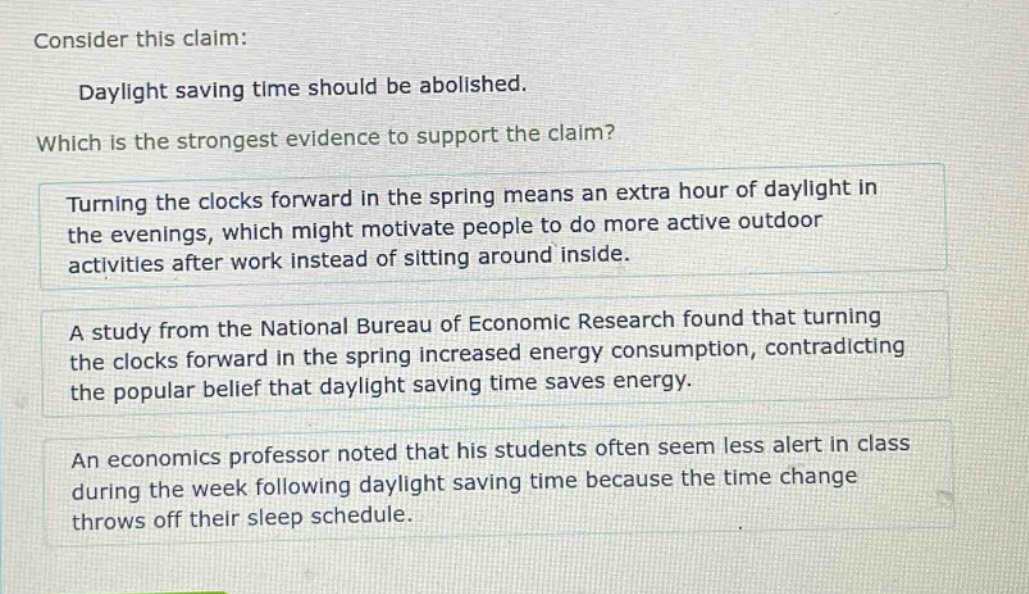
consider this claim: daylight saving time should be abolished. which is the strongest evidence to support the claim? turning the clocks forward in the spring means an extra hour of daylight in the evenings, which might motivate people to do more active outdoor activities after work instead of sitting around inside. a study from the national bureau of economic research found that turning the clocks forward in the spring increased energy consumption, contradicting the popular belief that daylight saving time saves energy. an economics professor noted that his students often seem less alert in class during the week following daylight saving time because the time change throws off their sleep schedule.
Answer
Brief Explanations:
The claim is to abolish daylight - saving time. The first option is a positive of daylight - saving time, so it doesn't support the claim. The second option from a reputable source (National Bureau of Economic Research) shows that daylight - saving time doesn't achieve the energy - saving goal it was meant for, which is a strong reason to abolish it. The third option is about a specific group (students) and a short - term effect (less alertness in class for a week), which is less strong compared to the energy - related evidence.
Answer:
A study from the National Bureau of Economic Research found that turning the clocks forward in the spring increased energy consumption, contradicting the popular belief that daylight saving time saves energy.