despite all the attention paid to rogue companies like enron, academics know very little about the…
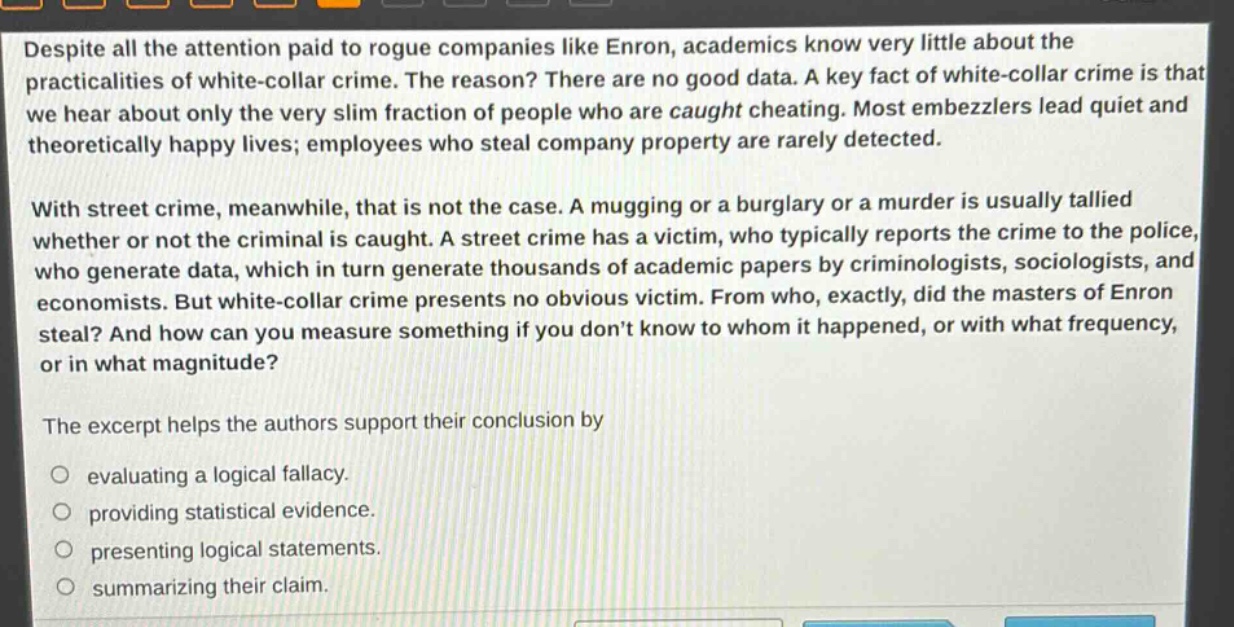
despite all the attention paid to rogue companies like enron, academics know very little about the practicalities of white - collar crime. the reason? there are no good data. a key fact of white - collar crime is that we hear about only the very slim fraction of people who are caught cheating. most embezzlers lead quiet and theoretically happy lives; employees who steal company property are rarely detected.\n\nwith street crime, meanwhile, that is not the case. a mugging or a burglary or a murder is usually tallied whether or not the criminal is caught. a street crime has a victim, who typically reports the crime to the police, who generate data, which in turn generate thousands of academic papers by criminologists, sociologists, and economists. but white - collar crime presents no obvious victim. from who, exactly, did the masters of enron steal? and how can you measure something if you dont know to whom it happened, or with what frequency, or in what magnitude?\n\nthe excerpt helps the authors support their conclusion by\n○ evaluating a logical fallacy.\n○ providing statistical evidence.\n○ presenting logical statements.\n○ summarizing their claim.
Answer
Brief Explanations:
The text presents logical statements comparing street - crime and white - collar crime. It uses reasoning to explain why academics know little about white - collar crime (lack of data due to no obvious victims) as opposed to street - crime (where victims report and data is generated). It does not evaluate a logical fallacy, provide statistical evidence, or summarize a claim in the way these options suggest.
Answer:
presenting logical statements.