document 1\n1. what is the difference between a capitalist economy and a command economy?\n2. in a market…
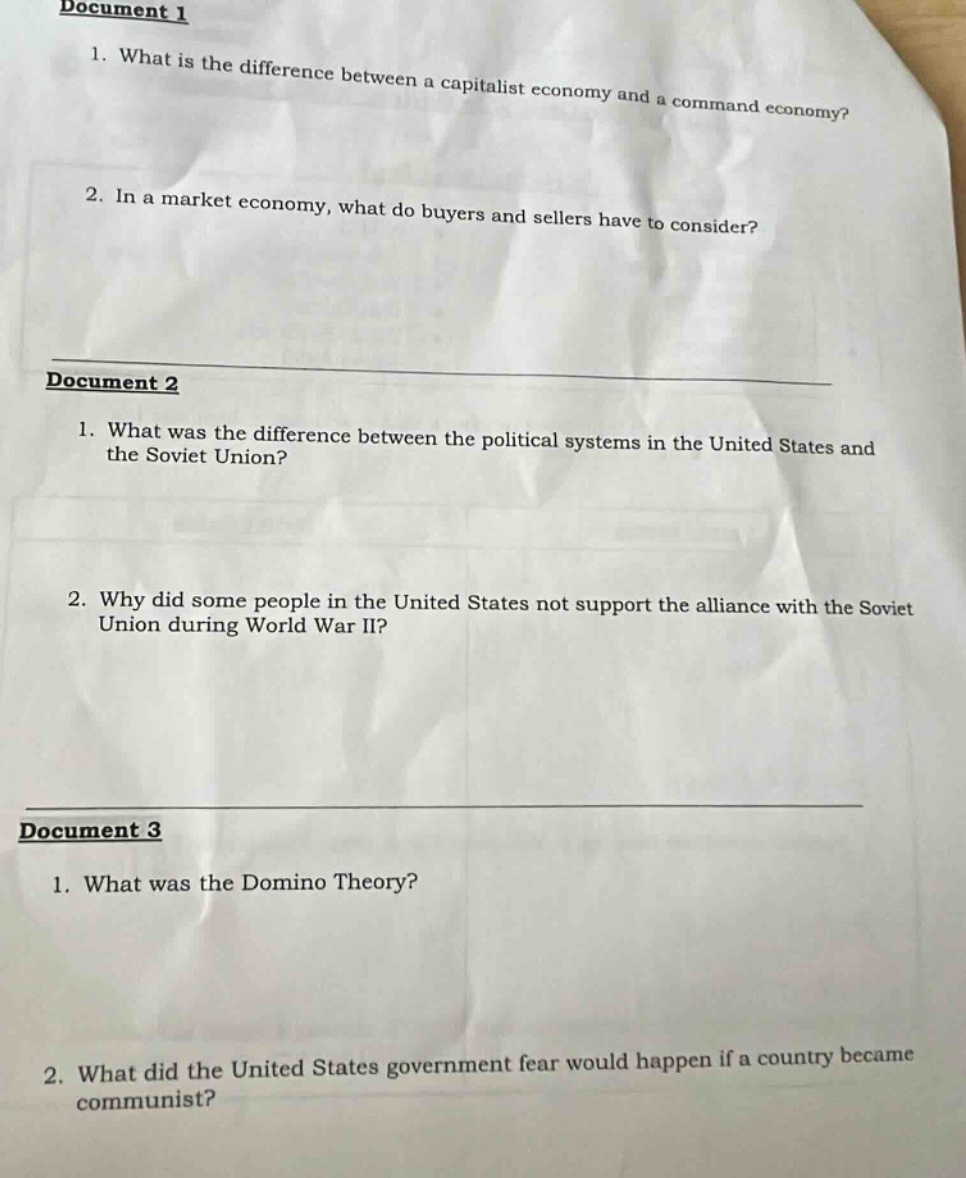
document 1\n1. what is the difference between a capitalist economy and a command economy?\n2. in a market economy, what do buyers and sellers have to consider?\ndocument 2\n1. what was the difference between the political systems in the united states and the soviet union?\n2. why did some people in the united states not support the alliance with the soviet union during world war ii?\ndocument 3\n1. what was the domino theory?\n2. what did the united states government fear would happen if a country became communist?
Answer
Brief Explanations:
- In a capitalist economy, private - ownership and market - driven decisions prevail. In a command economy, the state controls production and distribution.
- Buyers and sellers in a market economy consider price, quantity, quality, and market competition.
- The US had a democratic, capitalist - based political system with a multi - party system. The Soviet Union had a one - party communist system with state - controlled economy.
- Some in the US opposed the alliance with the Soviet Union during WWII due to ideological differences (capitalism vs. communism), and pre - war anti - Soviet sentiment.
- The Domino Theory posited that if one country in a region became communist, neighboring countries would follow suit.
- The US government feared that if a country became communist, it would align with the Soviet bloc, spread communism further, and undermine US interests and the capitalist world - order.
Answer:
- In a capitalist economy, there is private ownership and market - driven decisions; in a command economy, the state controls production and distribution.
- Price, quantity, quality, and market competition.
- The US had a democratic, multi - party, capitalist - based system; the Soviet Union had a one - party communist system with state - controlled economy.
- Ideological differences (capitalism vs. communism) and pre - war anti - Soviet sentiment.
- The idea that if one country in a region became communist, neighboring countries would follow.
- It would align with the Soviet bloc, spread communism further, and undermine US interests and the capitalist world - order.