evaluating argumentative texts: mastery test\nwhich sentence in the excerpt presents a counter…
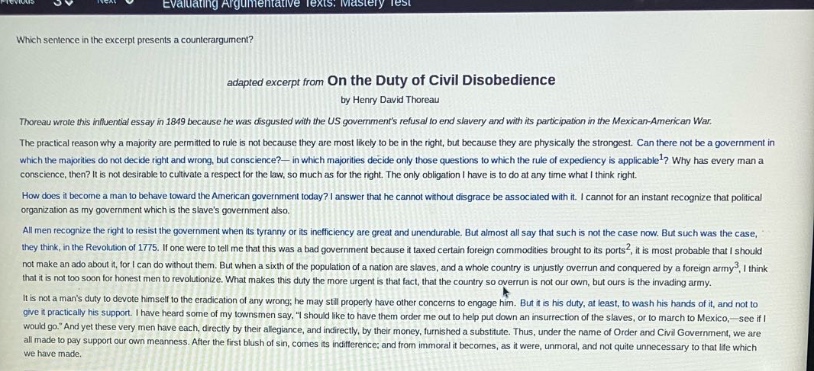
evaluating argumentative texts: mastery test\nwhich sentence in the excerpt presents a counter - argument?\nadapted excerpt from on the duty of civil disobedience\nby henry david thoreau\nthoreau wrote this influential essay in 1849 because he was disgusted with the us governments refusal to end slavery and with its participation in the mexican - american war.\nthe practical reason why a majority are permitted to rule is not because they are most likely to be in the right, but because they are physically the strongest. can there not be a government in which majorities do not decide right and wrong, but conscience? — in which majorities decide only those questions to which the rule of expediency is applicable? why has every man a conscience, then? it is not desirable to cultivate a respect for the law, so much as for the right. only obligation i have to do at any time what i think right.\nhow does it become a man to behave toward the american government today? i answer that he cannot without disgrace be associated with it. i cannot for an instant recognize that political organization as my government which is the slaves government also.\nall men recognize the right to resist the government when its tyranny or its inefficiency are great and unendurable. but almost all say that such is not the case now. but such was the case, they think, in the revolution of 1775. if one were to tell me that this was a bad government because it taxed certain foreign commodities brought to its ports, it is most probable that i should not make an ado about it, for it does not concern me. but when a sixth of the population of a nation are slaves, and a whole country is unjustly overrun and conquered by a foreign army, i think that it is not too soon for honest men to revolutionize. what makes this duty the more urgent is that fact, that the country so overrun is not our own, but ours is the invading army.\nit is not a mans duty to devote himself to the eradication of any wrong; he may still properly have other concerns to engage him. but it is his duty, at least, to wash his hands of it, and not to give it practically his support. i have heard some of my townsmen say, i should like to have them order me out to help put down the slaves, or to march to mexico, — see if i would go. and yet these very men have each, directly by their allegiance, and indirectly, by their money, furnished a substitute. thus, under the name of order and civil government, we are all made to support our own meanness. after the first blush of sin, comes its indifference; and from immoral it becomes, as it were, unmoral, and not quite unnecessary to that life which we have made.
Answer
Brief Explanations:
A counter - argument presents a view contrary to the main argument. In the excerpt, "All men recognize the right to resist the government when its tyranny or its inefficiency are great and unendurable. But almost all say that such is not the case now." presents a counter - argument. It first acknowledges a general view (the right to resist in certain circumstances) and then contradicts it by stating that most people think the current situation does not warrant resistance.
Answer:
All men recognize the right to resist the government when its tyranny or its inefficiency are great and unendurable. But almost all say that such is not the case now.