which of the following explanations represents why taste aversion breaks the rules of conditioning? a. taste…
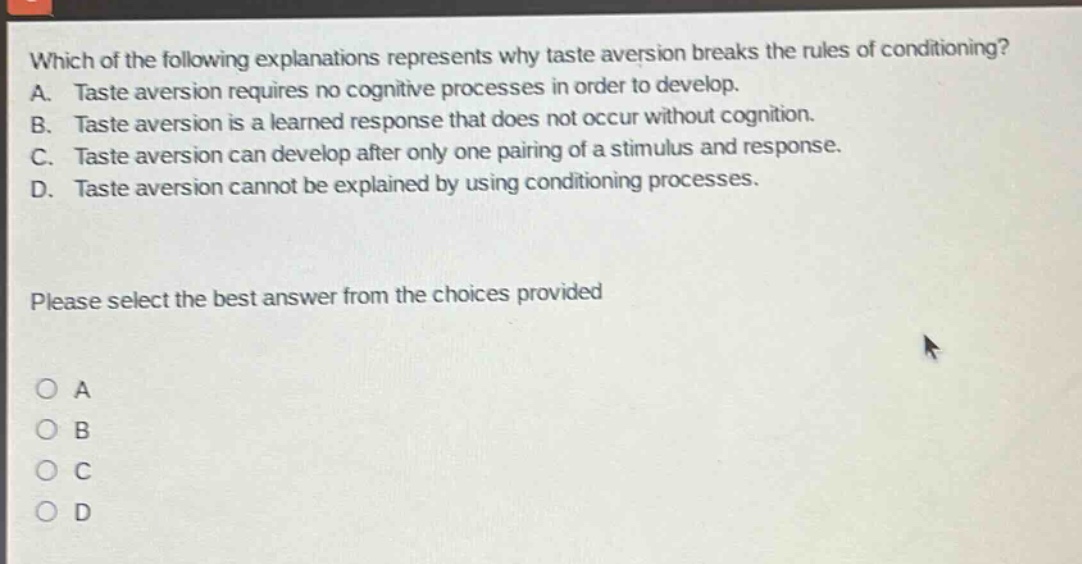
which of the following explanations represents why taste aversion breaks the rules of conditioning? a. taste aversion requires no cognitive processes in order to develop. b. taste aversion is a learned response that does not occur without cognition. c. taste aversion can develop after only one pairing of a stimulus and response. d. taste aversion cannot be explained by using conditioning processes. please select the best answer from the choices provided
Answer
Brief Explanations:
Classical conditioning usually requires multiple pairings of a neutral stimulus and an unconditioned stimulus to form an association. Taste - aversion can develop after just one pairing of a taste (stimulus) and a negative experience (response), which breaks the typical rules of conditioning.
Answer:
C. Taste aversion can develop after only one pairing of a stimulus and response.