formal public apology from the u.s. government until president bill clinton apologized in 1997.\n1. what…
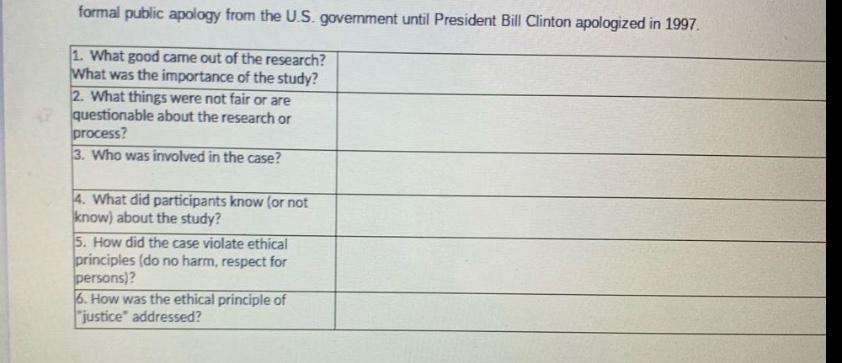
formal public apology from the u.s. government until president bill clinton apologized in 1997.\n1. what good came out of the research?\nwhat was the importance of the study?\n2. what things were not fair or\nquestionable about the research or\nprocess?\n3. who was involved in the case?\n4. what did participants know (or not\nknow) about the study?\n5. how did the case violate ethical\nprinciples (do no harm, respect for\npersons)?\n6. how was the ethical principle of\n\justice\ addressed?
Answer
Brief Explanations:
- Without specific information about the research, it's hard to say what good came out. Importance could be in knowledge - building if done right.
- Unfairness could be in participant selection, lack of informed consent etc. Questionable aspects might include unethical treatment.
- Likely researchers, participants and potentially government or institutional bodies were involved.
- If it was unethical, participants likely had incomplete or no knowledge about the true nature of the study.
- If there was harm done or lack of respect for participants' autonomy, ethical principles were violated.
- Justice could be addressed by compensating victims, acknowledging wrong - doing etc. But details depend on the case.
Answer:
- Insufficient information to determine specific good and importance.
- Unfairness and questionable aspects could be in consent, treatment.
- Researchers, participants, possible institutional/government bodies.
- Likely had incomplete or no knowledge if unethical.
- Harm or lack of respect for autonomy could be violations.
- Depends on case, could involve compensation, acknowledgment.