a free negro of the african race, whose ancestors were brought to this country and sold as slaves, is not a…
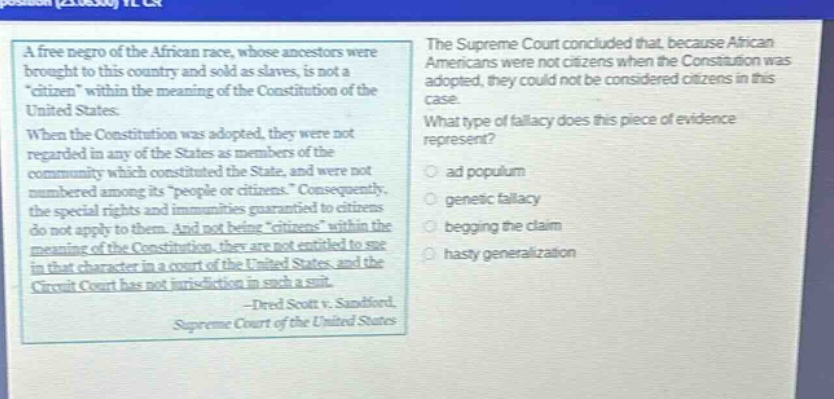
a free negro of the african race, whose ancestors were brought to this country and sold as slaves, is not a \citizen\ within the meaning of the constitution of the united states. when the constitution was adopted, they were not regarded in any of the states as members of the community which constituted the state, and were not numbered among its \people or citizens.\ consequently, the special rights and immunities guaranteed to citizens do not apply to them. and not being \citizens\ within the meaning of the constitution, they are not entitled to sue in that character in a court of the united states, and the circuit court has not jurisdiction in such a suit. -dred scott v. sandford, supreme court of the united states\nthe supreme court concluded that, because african americans were not citizens when the constitution was adopted, they could not be considered citizens in this case. what type of fallacy does this piece of evidence represent?\n○ ad populum\n○ genetic fallacy\n○ begging the claim\n○ hasty generalization
Answer
Brief Explanations:
The Supreme - Court's conclusion assumes what it is trying to prove, that African - Americans are not citizens because they were not considered citizens at the time of the Constitution's adoption. This is begging the claim, also known as circular reasoning. It uses the conclusion as a premise in the argument.
Answer:
begging the claim