general george custer was defeated by crazy horse and the lakota sioux * 1 point\no the battle of little…
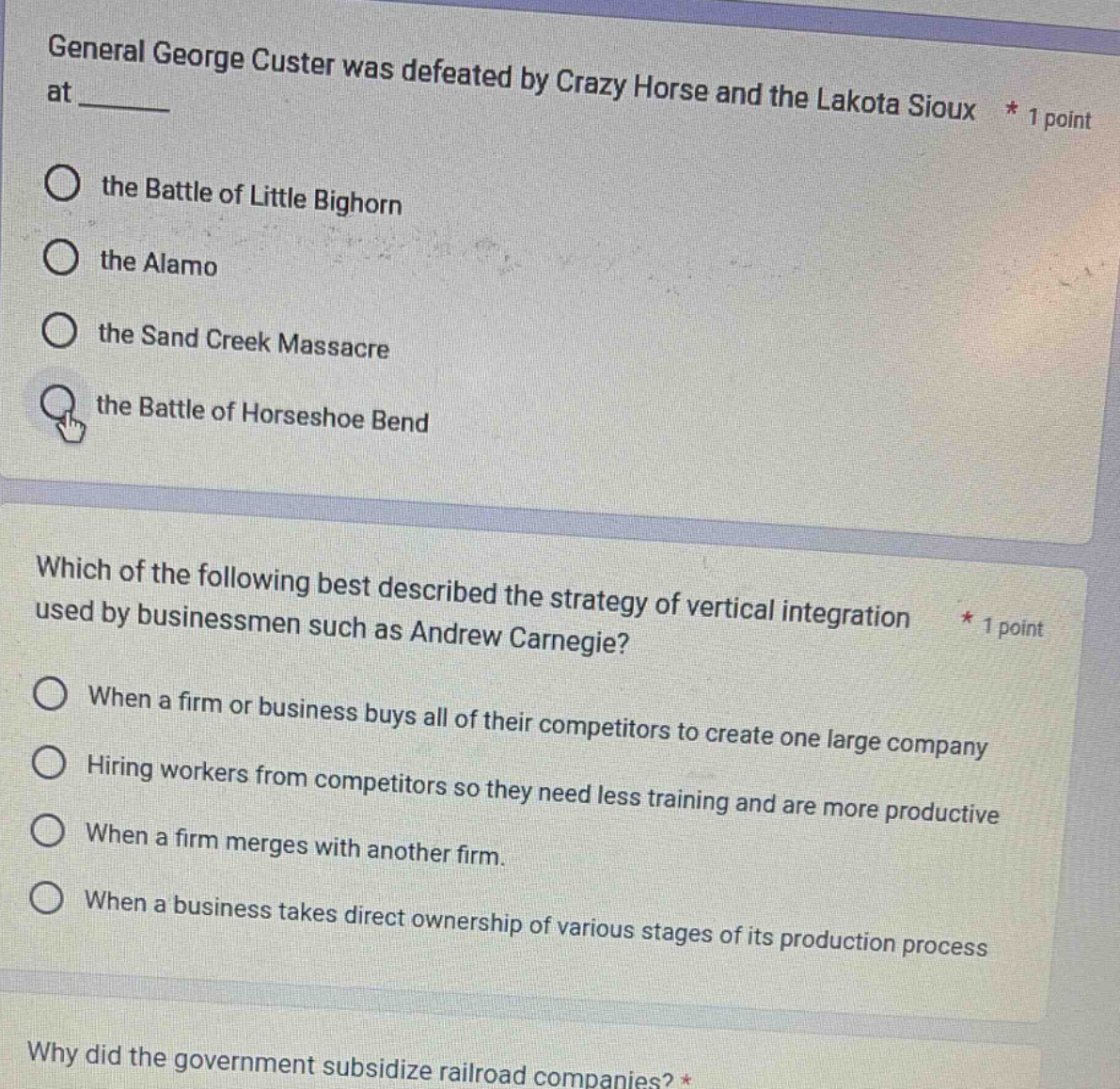
general george custer was defeated by crazy horse and the lakota sioux * 1 point\no the battle of little bighorn\no the alamo\no the sand creek massacre\no the battle of horseshoe bend\n\nwhich of the following best described the strategy of vertical integration used by businessmen such as andrew carnegie? * 1 point\no when a firm or business buys all of their competitors to create one large company\no hiring workers from competitors so they need less training and are more productive\no when a firm merges with another firm.\no when a business takes direct ownership of various stages of its production process\n\nwhy did the government subsidize railroad companies? *
Answer
Brief Explanations:
- General George Custer was defeated by Crazy Horse and the Lakota Sioux at the Battle of Little Bighorn. This was a significant conflict in American - Indian history.
- Vertical integration, as used by Andrew Carnegie, is when a business takes direct ownership of various stages of its production process. This allows for more control over the supply chain and cost - efficiency.
Answer:
- A. the Battle of Little Bighorn
- D. When a business takes direct ownership of various stages of its production process