identifying plate boundary through models\nuse the drop down menus to answer the questions.\nin what type of…
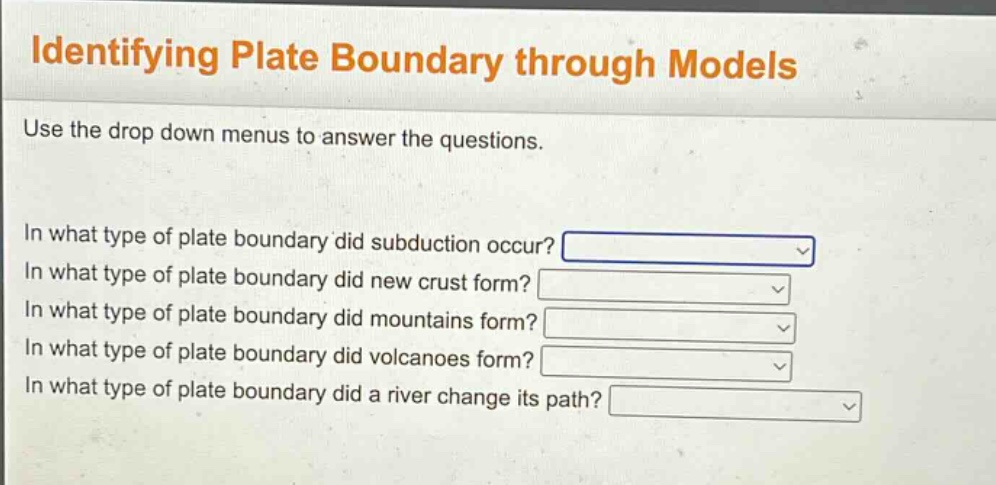
identifying plate boundary through models\nuse the drop down menus to answer the questions.\nin what type of plate boundary did subduction occur?\nin what type of plate boundary did new crust form?\nin what type of plate boundary did mountains form?\nin what type of plate boundary did volcanoes form?\nin what type of plate boundary did a river change its path?
Answer
Brief Explanations:
Subduction occurs at convergent plate boundaries where one tectonic plate moves under another. New crust forms at divergent plate boundaries as magma rises and solidifies. Mountains often form at convergent plate boundaries due to the collision and compression of plates. Volcanoes commonly form at convergent (where subduction occurs and melts the mantle) and divergent plate boundaries (where magma reaches the surface). A river changing its path is not directly related to plate - boundary processes but if forced to choose, it has the least connection compared to the others and is not a typical plate - boundary related phenomenon.
Answer:
- Convergent
- Divergent
- Convergent
- Convergent and Divergent
- None of the typical plate - boundary types (as rivers changing path are mainly due to erosion, sedimentation etc. not plate - boundary dynamics)