the main, or central, idea of the passage is people with synesthesia experience a fusing of different…
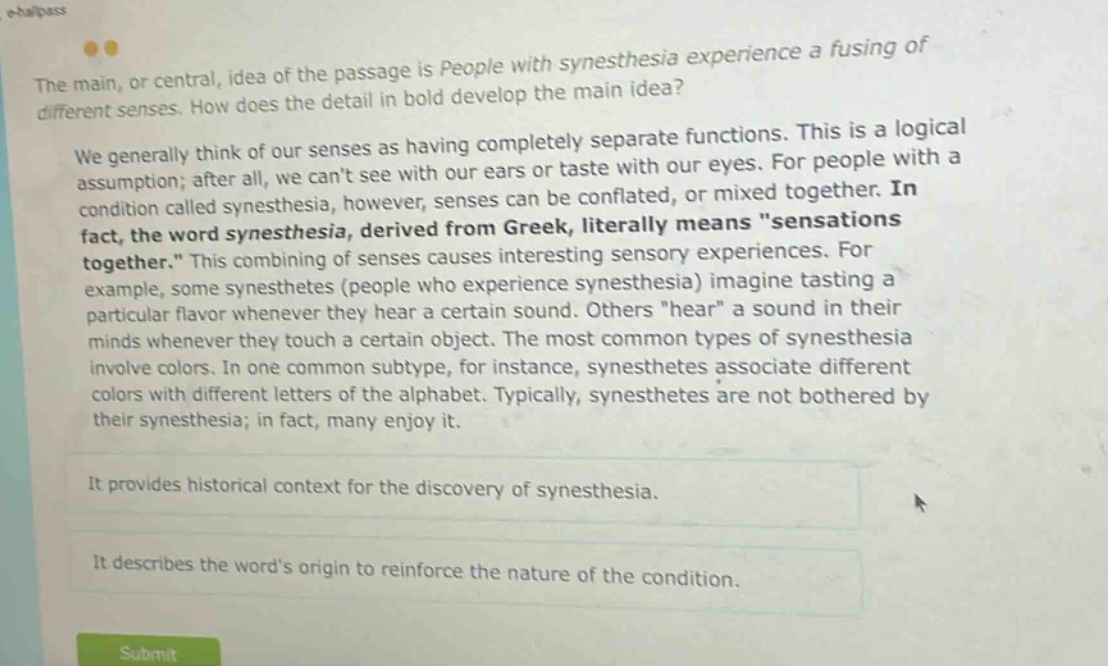
the main, or central, idea of the passage is people with synesthesia experience a fusing of different senses. how does the detail in bold develop the main idea? we generally think of our senses as having completely separate functions. this is a logical assumption; after all, we cant see with our ears or taste with our eyes. for people with a condition called synesthesia, however, senses can be conflated, or mixed together. in fact, the word synesthesia, derived from greek, literally means \sensations together.\ this combining of senses causes interesting sensory experiences. for example, some synesthetes (people who experience synesthesia) imagine tasting a particular flavor whenever they hear a certain sound. others \hear\ a sound in their minds whenever they touch a certain object. the most common types of synesthesia involve colors. in one common subtype, for instance, synesthetes associate different colors with different letters of the alphabet. typically, synesthetes are not bothered by their synesthesia; in fact, many enjoy it. it provides historical context for the discovery of synesthesia. it describes the words origin to reinforce the nature of the condition.
Answer
Brief Explanations:
The text mentions that the word "synesthesia" is derived from Greek and means "sensations together", which ties into the idea of senses being mixed for those with synesthesia, reinforcing the nature of the condition. It doesn't provide historical context for the discovery.
Answer:
It describes the word’s origin to reinforce the nature of the condition.