why is the minimum - wage controversial?\nopponents of the minimum wage argue that it harms business profits…
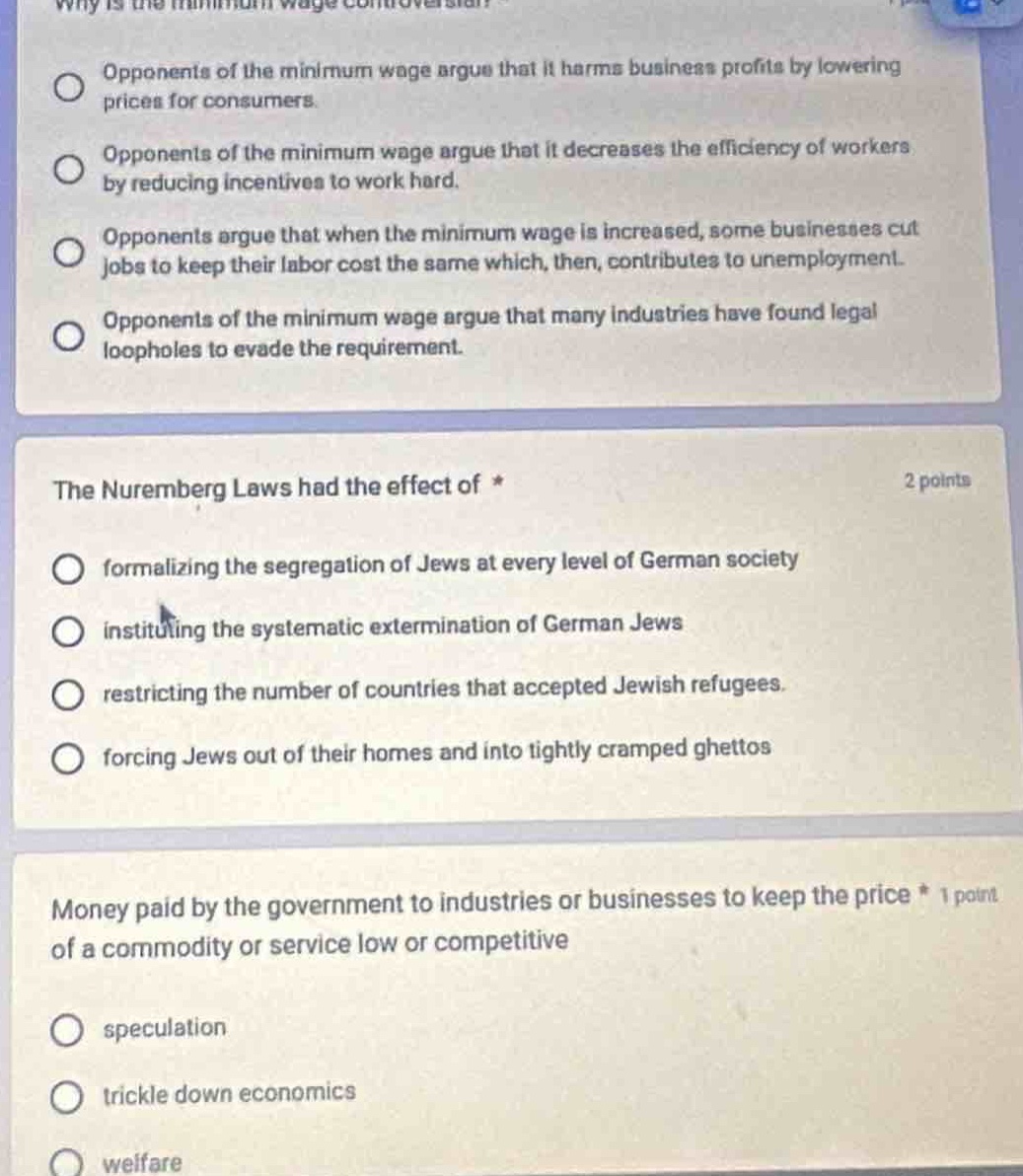
why is the minimum - wage controversial?\nopponents of the minimum wage argue that it harms business profits by lowering prices for consumers.\nopponents of the minimum wage argue that it decreases the efficiency of workers by reducing incentives to work hard.\nopponents argue that when the minimum wage is increased, some businesses cut jobs to keep their labor cost the same which, then, contributes to unemployment.\nopponents of the minimum wage argue that many industries have found legal loopholes to evade the requirement.\n\nthe nuremberg laws had the effect of * 2 points\nformalizing the segregation of jews at every level of german society\ninstituting the systematic extermination of german jews\nrestricting the number of countries that accepted jewish refugees.\nforcing jews out of their homes and into tightly cramped ghettos\n\nmoney paid by the government to industries or businesses to keep the price * 1 point of a commodity or service low or competitive\nspeculation\ntrickle - down economics\nwelfare
Answer
Brief Explanations:
- The controversy over minimum - wage often centers around its impact on employment. When minimum wage is increased, businesses may cut jobs to control labor costs, leading to unemployment.
- The Nuremberg Laws in Nazi - Germany formalized the segregation of Jews at every level of German society, restricting their rights and freedoms.
- Subsidies are payments by the government to industries or businesses to keep the price of a commodity or service low or competitive. Welfare is more about assistance to individuals or families in need, trickle - down economics is an economic theory about tax cuts for the wealthy benefiting the whole economy, and speculation is about risky financial trading.
Answer:
- Opponents argue that when the minimum wage is increased, some businesses cut jobs to keep their labor cost the same which, then, contributes to unemployment.
- formalizing the segregation of Jews at every level of German society
- welfare (Note: The correct term should be subsidy, but among the given options, welfare is the closest in the sense of government support, though not entirely accurate)