part i\nanswer all 24 questions in this part. each correct answer will receive 2 credits. no partial credit…
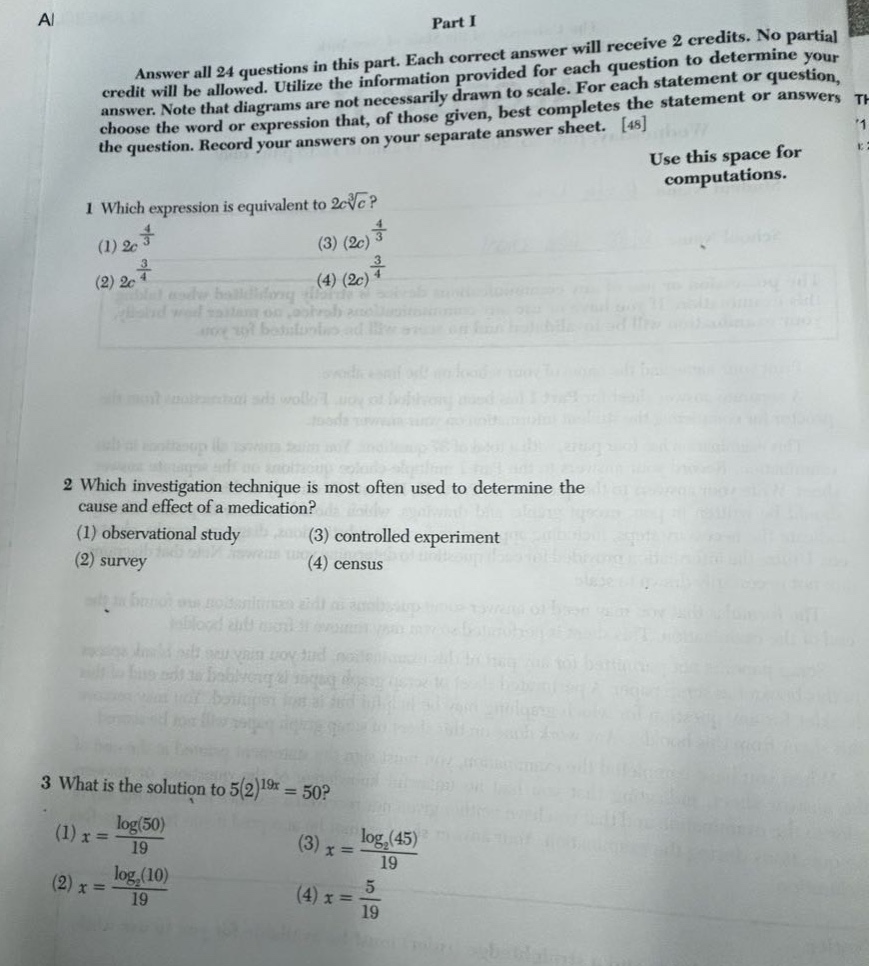
part i\nanswer all 24 questions in this part. each correct answer will receive 2 credits. no partial credit will be allowed. utilize the information provided for each question to determine your answer. note that diagrams are not necessarily drawn to scale. for each statement or question, choose the word or expression that, of those given, best completes the statement or answers the question. record your answers on your separate answer sheet. 48\nuse this space for computations.\n1 which expression is equivalent to 2c\\sqrt4{c}?\n(1) 2c^{\\frac{4}{3}}\n(3) (2c)^{\\frac{4}{3}}\n(2) 2c^{\\frac{3}{4}}\n(4) (2c)^{\\frac{3}{4}}\n2 which investigation technique is most often used to determine the cause and effect of a medication?\n(1) observational study\n(3) controlled experiment\n(2) survey\n(4) census\n3 what is the solution to 5(2)^{19x}=50?\n(1) x = \\frac{\\log(50)}{19}\n(3) x = \\frac{\\log_2(45)}{19}\n(2) x = \\frac{\\log_2(10)}{19}\n(4) x = \\frac{5}{19}
Answer
Pregunta 1
Explicación:
Paso 1: Aplicar la regla de exponentes para la raíz cúbica
Recordar que $\sqrt[3]{c}=c^{\frac{1}{3}}$. Entonces $2c\sqrt[3]{c}=2c\times c^{\frac{1}{3}}$.
Paso 2: Aplicar la regla de exponentes $a^m\times a^n=a^{m + n}$
$2c\times c^{\frac{1}{3}}=2c^{1+\frac{1}{3}}=2c^{\frac{3 + 1}{3}}=2c^{\frac{4}{3}}$.
Respuesta:
(1) $2c^{\frac{4}{3}}$
Pregunta 2
Explicación breve:
Un experimento controlado es la técnica más adecuada para determinar causa - efecto. Permite manipular variables independientes y controlar factores externos.
Respuesta:
(3) experimento controlado
Pregunta 3
Explicación:
Paso 1: Dividir ambos lados de la ecuación por 5
Dada $5(2)^{19x}=50$, dividiendo por 5 obtenemos $(2)^{19x}=10$.
Paso 2: Aplicar logaritmo en base 2 a ambos lados
$\log_2(2)^{19x}=\log_2(10)$.
Paso 3: Utilizar la propiedad $\log_a(a^b)=b$
$19x=\log_2(10)$.
Paso 4: Resolver para $x$
$x = \frac{\log_2(10)}{19}$.
Respuesta:
(2) $x=\frac{\log_2(10)}{19}$