what potential cognitive biases might influence an individuals time versus money decision - making…
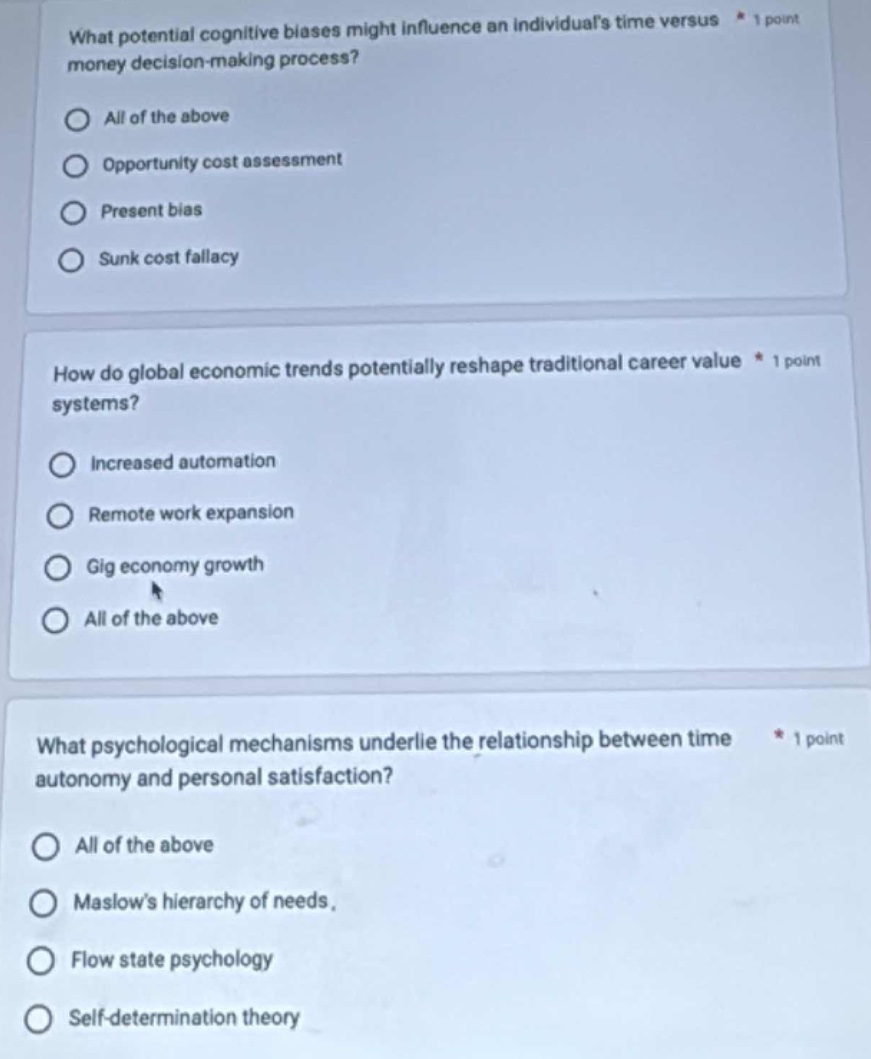
what potential cognitive biases might influence an individuals time versus money decision - making process?\nall of the above\nopportunity cost assessment\npresent bias\nsunk cost fallacy\n\nhow do global economic trends potentially reshape traditional career value systems?\nincreased automation\nremote work expansion\ngig economy growth\nall of the above\n\nwhat psychological mechanisms underlie the relationship between time autonomy and personal satisfaction?\nall of the above\nmaslows hierarchy of needs.\nflow state psychology\nself - determination theory
Answer
Brief Explanations:
- First question: Opportunity cost assessment is a rational - economic concept, not a cognitive bias. Present bias makes individuals prefer immediate rewards over future ones, and the sunk - cost fallacy leads people to continue investing in something because of past investments. So, present bias and sunk - cost fallacy are cognitive biases that can influence time - money decision - making.
- Second question: Increased automation, remote work expansion, and gig economy growth are all global economic trends that can reshape traditional career value systems by changing job requirements, work arrangements, and career stability.
- Third question: Maslow's hierarchy of needs, flow state psychology, and self - determination theory all explain psychological mechanisms related to how time autonomy can affect personal satisfaction. For example, self - determination theory emphasizes autonomy as a basic psychological need, and flow state can be achieved with appropriate time and task autonomy.
Answer:
- Present bias, Sunk cost fallacy
- All of the above
- All of the above