what power is held by the florida supreme court and the u.s. supreme court?\nboth courts may issue writs of…
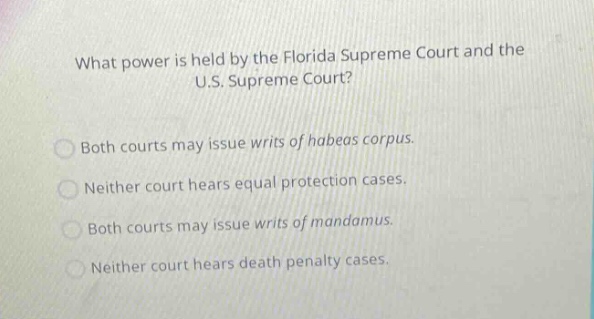
what power is held by the florida supreme court and the u.s. supreme court?\nboth courts may issue writs of habeas corpus.\nneither court hears equal protection cases.\nboth courts may issue writs of mandamus.\nneither court hears death penalty cases.
Answer
Brief Explanations:
- Writs of habeas corpus: The U.S. Supreme Court has the power to issue writs of habeas corpus. State supreme courts, like the Florida Supreme Court, also have this power. A writ of habeas corpus is used to bring a person before a court to determine if their detention is lawful.
- Writs of mandamus: The U.S. Supreme Court has limited original jurisdiction for writs of mandamus. State supreme courts may have different rules regarding writs of mandamus compared to the U.S. Supreme Court in some aspects.
- Equal protection cases: Both federal (U.S. Supreme Court) and state (Florida Supreme Court) courts can hear equal protection cases as equal protection is a constitutional principle that can be litigated at both levels.
- Death penalty cases: Both state (Florida Supreme Court, as Florida has the death penalty) and federal (U.S. Supreme Court, when there are federal - related issues in death penalty cases) courts can hear death penalty cases.
Answer:
Both courts may issue writs of habeas corpus.