what can prevent a child from exercising his or her right to an education in some countries in the world…
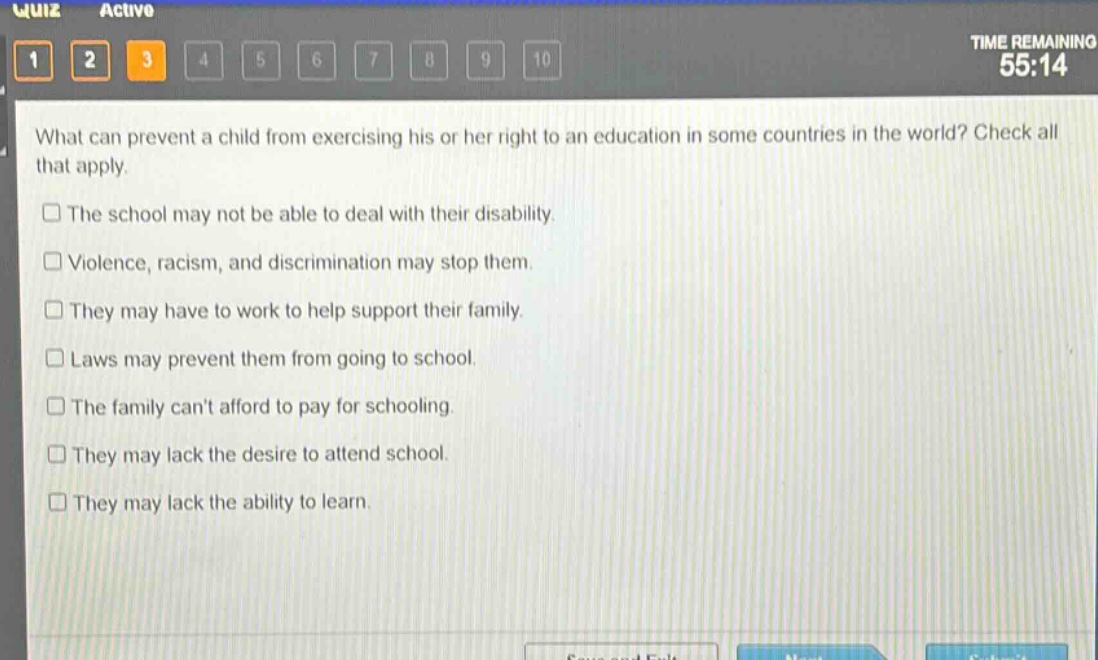
what can prevent a child from exercising his or her right to an education in some countries in the world? check all that apply.\nthe school may not be able to deal with their disability.\nviolence, racism, and discrimination may stop them.\nthey may have to work to help support their family.\nlaws may prevent them from going to school.\nthe family cant afford to pay for schooling.\nthey may lack the desire to attend school.\nthey may lack the ability to learn.
Answer
Answer:
- The school may not be able to deal with their disability.
- Violence, racism, and discrimination may stop them.
- They may have to work to help support their family.
- Laws may prevent them from going to school.
- The family can't afford to pay for schooling.
Brief Explanations:
- Disability - related barrier: If a school lacks the resources or knowledge to accommodate a child's disability (e.g., no special - education programs, inaccessible facilities), the child may be effectively denied an education.
- Social and cultural barriers (violence, racism, discrimination): In areas with high levels of violence (e.g., war - torn regions, areas with gang violence), schools may be unsafe. Racism and discrimination (e.g., against ethnic minorities, girls in some patriarchal societies) can lead to exclusion from educational institutions.
- Economic necessity (working to support family): In poor families, children may be forced into child labor (e.g., in agriculture, informal markets) to contribute to the family income, leaving no time for school.
- Legal barriers: Some countries may have discriminatory laws (e.g., in the past, laws that restricted education for certain racial groups in some parts of the world) or laws that prioritize other interests over education (e.g., laws that allow early marriage for girls, which often ends their educational journey).
- Financial barriers (unaffordable schooling): If families cannot pay for school fees, uniforms, books, or transportation (common in low - income countries), children may be unable to attend school.
The options "They may lack the desire to attend school" and "They may lack the ability to learn" are not valid in the context of a child's right to education. Every child has the right to an education regardless of their initial desire (as education can also shape desires) and ability (with proper support, most children can learn).