question 4\n15 points\nrevolution/protest songs\nselect one of the \top 50\ songs about protest/revolution…
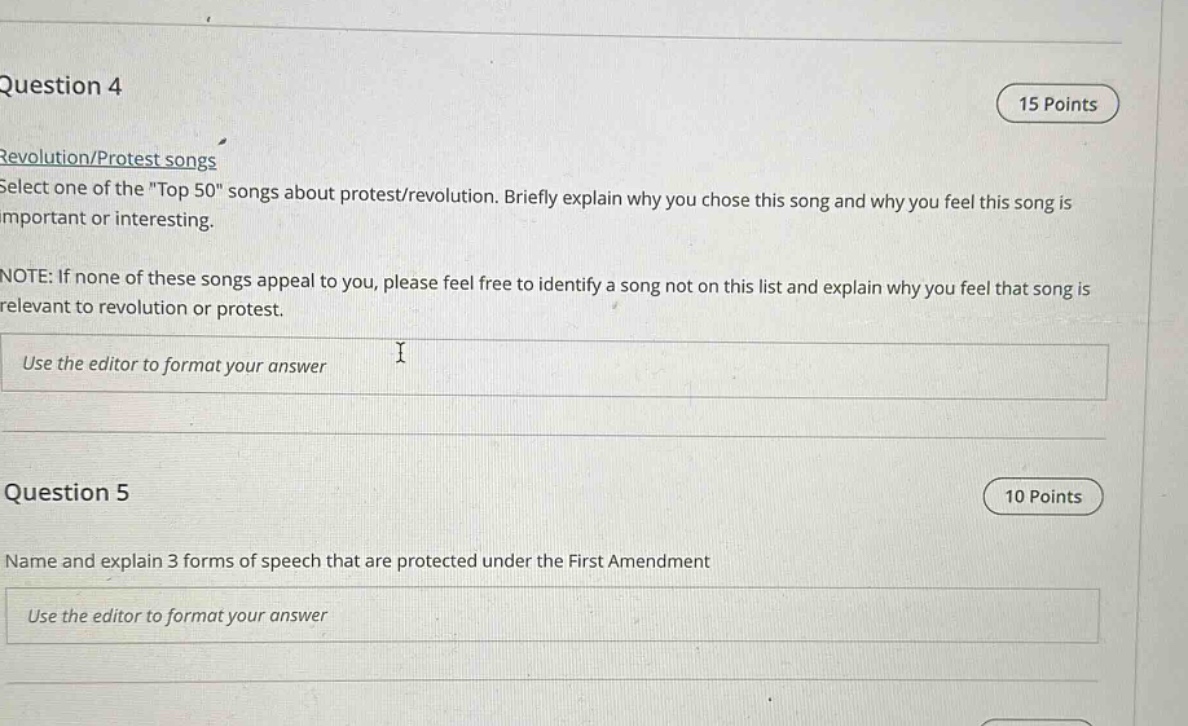
question 4\n15 points\nrevolution/protest songs\nselect one of the \top 50\ songs about protest/revolution. briefly explain why you chose this song and why you feel this song is important or interesting.\nnote: if none of these songs appeal to you, please feel free to identify a song not on this list and explain why you feel that song is relevant to revolution or protest.\nuse the editor to format your answer\nquestion 5\n10 points\nname and explain 3 forms of speech that are protected under the first amendment\nuse the editor to format your answer
Answer
Brief Explanations:
Question 4: Songs about protest/revolution often carry powerful messages and emotions related to social - change. One could choose a song like "Imagine" by John Lennon. It was chosen because of its universal message of peace and a world without divisions. It is important as it has inspired generations to think about a more harmonious world, transcending national, religious, and economic barriers. Question 5: Three forms of speech protected under the First Amendment in the United States are political speech (which allows citizens to discuss and advocate for political ideas and candidates, essential for a democratic society), religious speech (protects the free exercise of religion and the right to express religious beliefs), and artistic speech (covers various forms of creative expression like music, painting, and literature, allowing for the free flow of ideas and creativity).
Answer:
Question 4: For example, "Imagine" by John Lennon was chosen for its universal message of peace and has inspired generations to envision a more harmonious world. Question 5: Political speech: Allows discussion of political ideas. Religious speech: Protects free - exercise of religion. Artistic speech: Covers creative expressions.