question 20\n\nchrista and sal are anticipating the birth of their first baby. before the baby arrives, they…
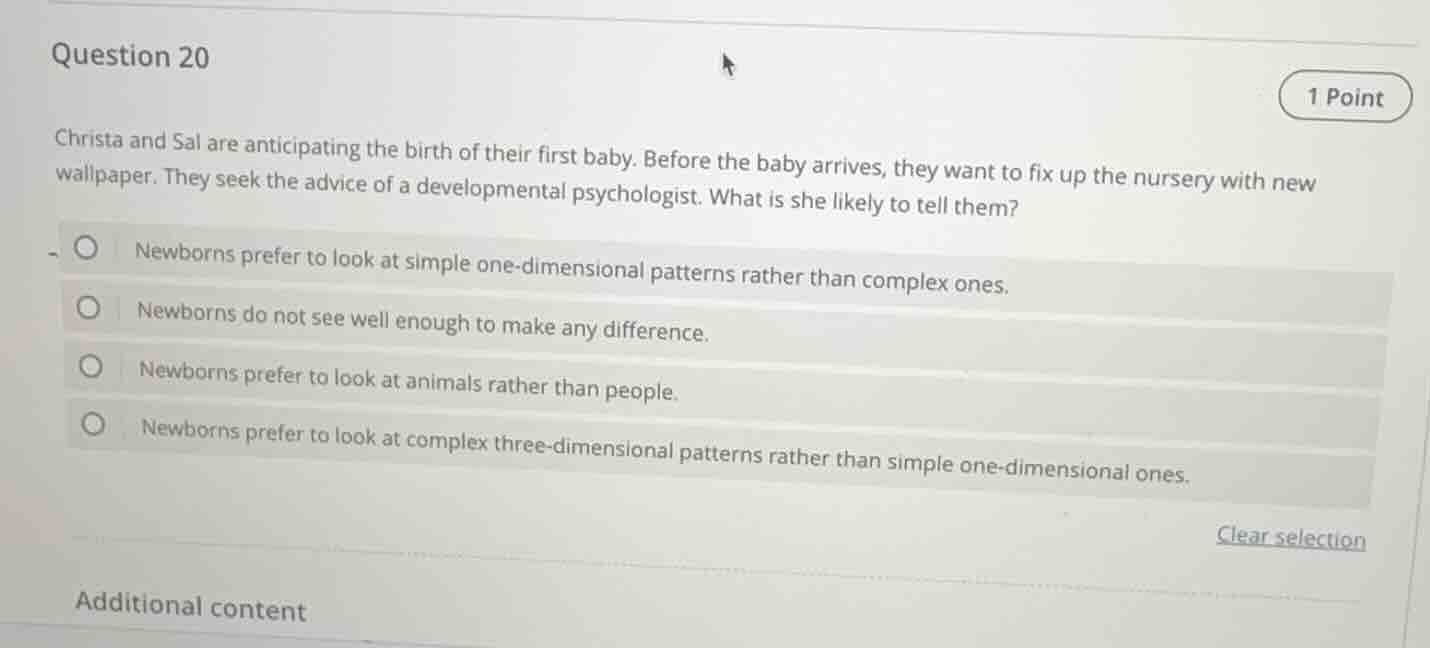
question 20\n\nchrista and sal are anticipating the birth of their first baby. before the baby arrives, they want to fix up the nursery with new wallpaper. they seek the advice of a developmental psychologist. what is she likely to tell them?\n\n- newborns prefer to look at simple one-dimensional patterns rather than complex ones.\n- newborns do not see well enough to make any difference.\n- newborns prefer to look at animals rather than people.\n- newborns prefer to look at complex three-dimensional patterns rather than simple one-dimensional ones.
Answer
Brief Explanations:
Developmental psychology research, particularly studies by Robert Fantz, indicates that newborns have specific visual preferences. While their visual acuity is limited, they are not blind to patterns. They consistently show a preference for complex patterns (such as checkerboards or faces) over plain or simple stimuli. Furthermore, they prefer three[LLM SSE On Failure]