question\n\naccording to 14 cfr part 107, how may a remote pic operate an unmanned aircraft in class c…
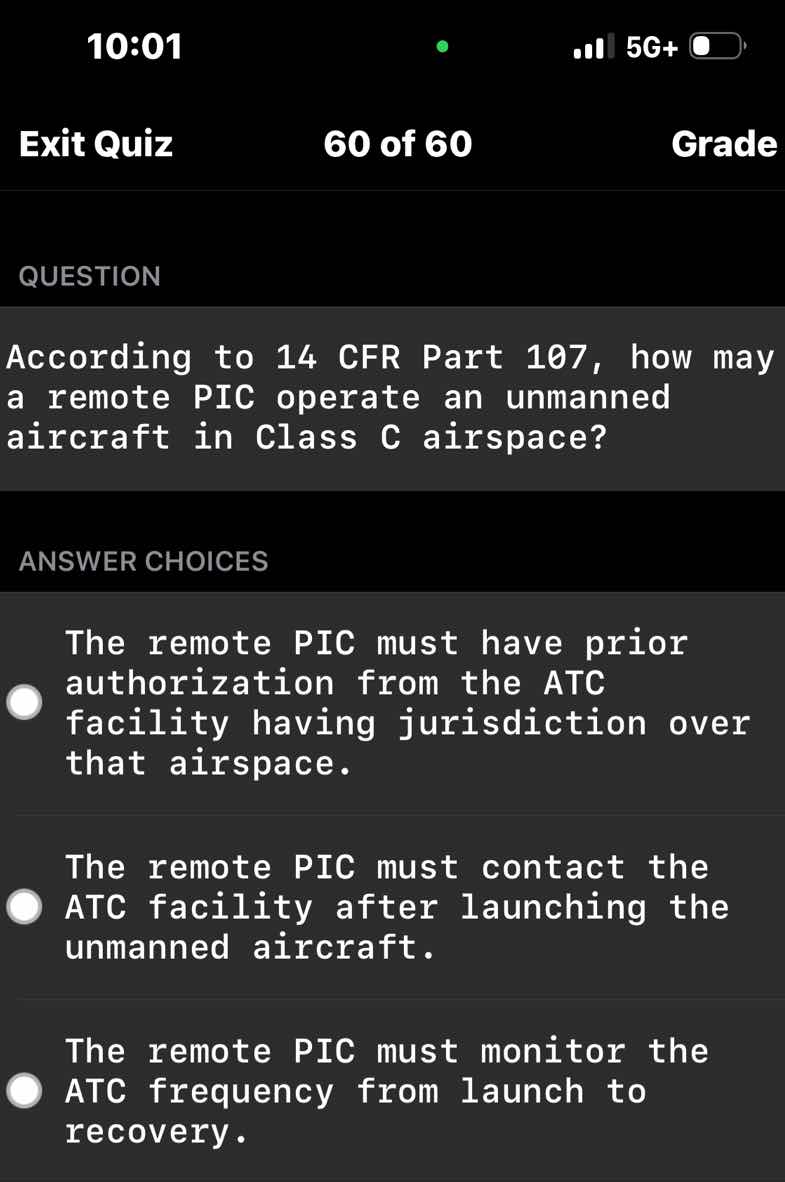
question\n\naccording to 14 cfr part 107, how may a remote pic operate an unmanned aircraft in class c airspace?\n\nanswer choices\n\nthe remote pic must have prior authorization from the atc facility having jurisdiction over that airspace.\n\nthe remote pic must contact the atc facility after launching the unmanned aircraft.\n\nthe remote pic must monitor the atc frequency from launch to recovery.
Answer
Brief Explanations:
Under 14 CFR Part 107.41, a remote Pilot in Command (PIC) is prohibited from operating a small unmanned aircraft in Class B, Class C, or Class D airspace, or within the lateral boundaries of the surface area of Class E airspace designated for an airport, unless they have prior authorization from Air Traffic Control (ATC). This authorization is typically obtained through the Low Altitude Authorization and Notification Capability (LAANC) or the FAA’s DroneZone portal. Simply monitoring frequencies or contacting ATC after launch does not satisfy the legal requirement for prior coordination and approval.
Answer:
The remote PIC must have prior authorization from the ATC facility having jurisdiction over that airspace.