question\n\nwhat would decrease the stability of an air mass?\n\nanswer choices\n\nwarming from…
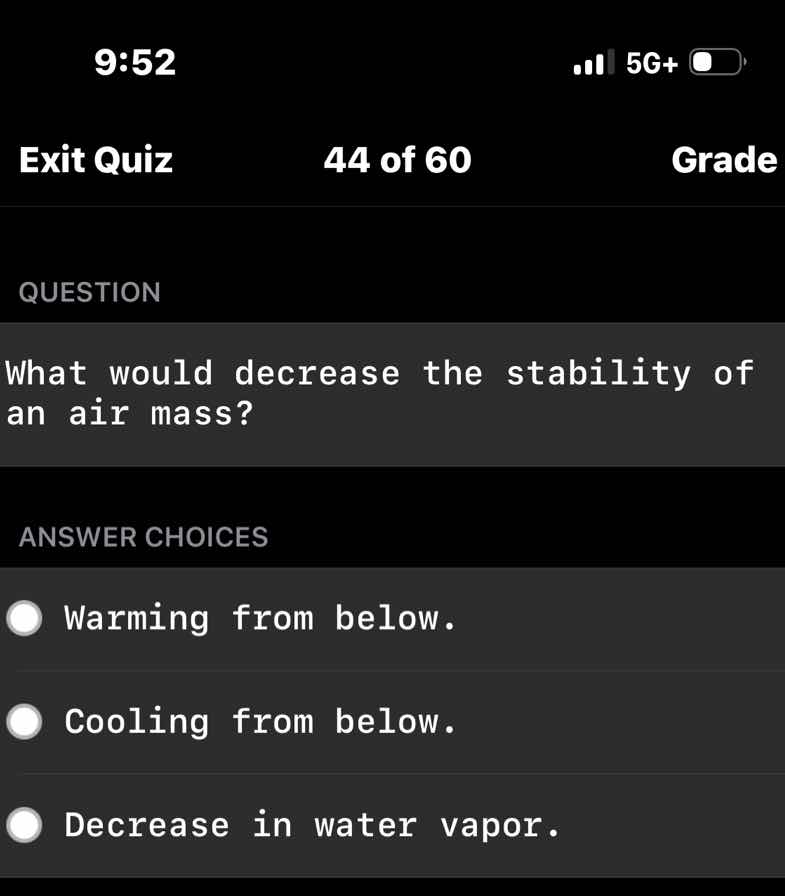
question\n\nwhat would decrease the stability of an air mass?\n\nanswer choices\n\nwarming from below.\n\ncooling from below.\n\ndecrease in water vapor.
Answer
Explanation:
Step1: Define atmospheric stability
Atmospheric stability refers to the resistance of the atmosphere to vertical motion. An air mass is unstable if a parcel of air, when displaced upward, continues to rise because it is warmer and less dense than its surroundings.
Step2: Analyze the effect of warming from below
When the surface or the lower part of an air mass is heated, the air becomes warmer and less dense. This increases the environmental lapse rate, making the air more buoyant and prone to rising, which decreases stability.
Step3: Analyze the effect of cooling from below
Cooling the bottom of an air mass makes the air denser and more stable, as it resists upward movement.
Step4: Analyze the effect of water vapor
Increasing water vapor decreases stability because moist air is less dense than dry air and releases latent heat upon condensation, further fueling upward motion. A decrease in water vapor would generally increase stability.
Answer:
Warming from below.