question 8 (mandatory) (10 points)\nthinking about your future career and working in the world of…
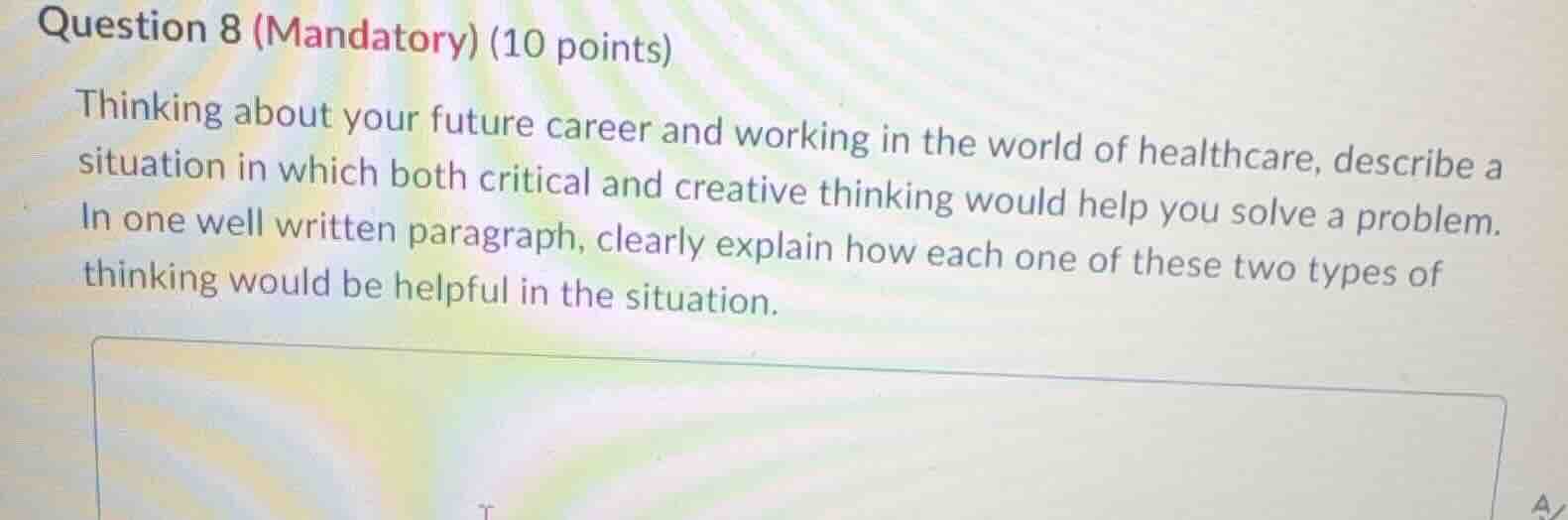
question 8 (mandatory) (10 points)\nthinking about your future career and working in the world of healthcare, describe a situation in which both critical and creative thinking would help you solve a problem. in one well written paragraph, clearly explain how each one of these two types of thinking would be helpful in the situation.
Answer
Brief Explanations:
Imagine working as a pediatric nurse where a young patient with a rare, treatment-resistant skin rash is not responding to standard topical medications. Critical thinking first helps you systematically rule out variables: you review the patient's medical history for unreported allergies, cross-reference the rash's progression against clinical guidelines, and verify that medication administration protocols were followed correctly, eliminating user error or misdiagnosis as factors. Creative thinking then comes into play when you recall a recent case study about using diluted, hypoallergenic natural oat extracts (typically used in over-the-counter skincare) as an adjunct treatment; you collaborate with the care team to design a safe, controlled trial of this approach, adapting a non-clinical product for a clinical use case. Critical thinking ensures the solution is evidence-based and low-risk, while creative thinking opens up alternative interventions beyond standard protocols.
Answer:
As a pediatric nurse, I would face a scenario where a young patient with a rare, treatment-resistant skin rash fails to improve with standard topical medications. Critical thinking would help me systematically review the patient's full medical history to rule out unreported allergies, cross-reference the rash's symptoms and progression against clinical guidelines to confirm the initial diagnosis is accurate, and verify that all medication administration protocols were followed correctly, eliminating preventable errors as a cause of the lack of improvement. Creative thinking would then allow me to adapt a non-traditional, evidence-informed solution: I would propose a controlled trial of diluted, hypoallergenic natural oat extract (a common over-the-counter skincare ingredient with anti-inflammatory properties) as an adjunct treatment, after recalling a recent case study on its off-label use for similar rare rashes, and collaborate with the care team to design a safe, monitored application plan that complements existing treatments. Together, critical thinking ensures the solution is grounded in safety and clinical rigor, while creative thinking unlocks an alternative intervention that standard protocols do not cover, leading to potential symptom relief for the patient.