question 5\nwhen you draw your weapon on duty, you must\n________.\n\nalways try to use your baton as a…
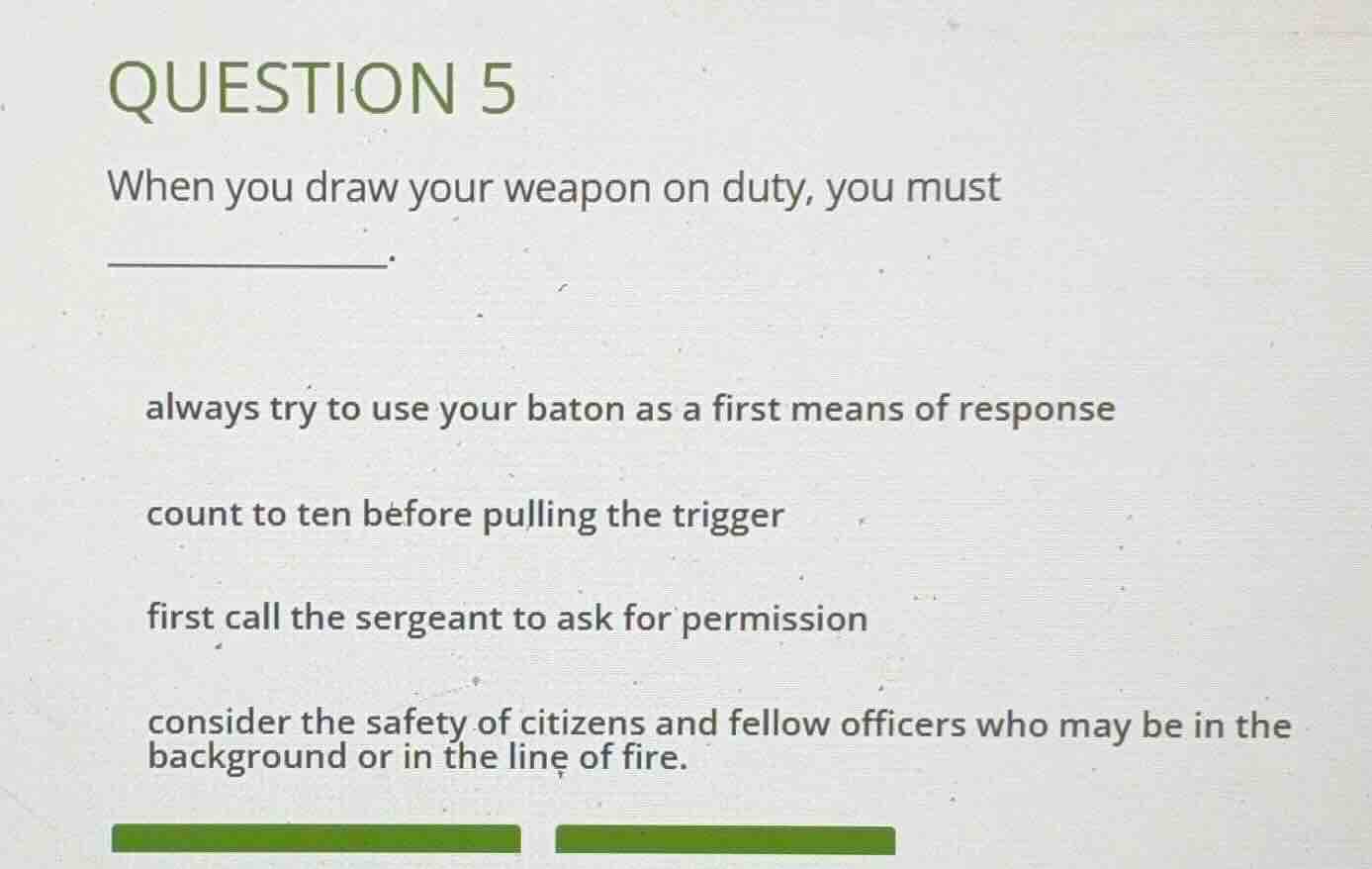
question 5\nwhen you draw your weapon on duty, you must\n________.\n\nalways try to use your baton as a first means of response\n\ncount to ten before pulling the trigger\n\nfirst call the sergeant to ask for permission\n\nconsider the safety of citizens and fellow officers who may be in the\nbackground or in the line of fire.
Answer
Brief Explanations:
- The option "always try to use your baton as a first means of response" is incorrect because drawing a weapon implies a situation where the baton may not be sufficient, and the focus when drawing a weapon is on safety, not necessarily using a baton first.
- "count to ten before pulling the trigger" is incorrect as in a real - life duty situation, there is no time for such a count, and the priority is safety and threat assessment.
- "first call the sergeant to ask for permission" is incorrect because in an emergent situation where a weapon needs to be drawn, there is no time to call for permission, and officers are trained to respond appropriately based on the situation.
- "consider the safety of citizens and fellow officers who may be in the background or in the line of fire" is correct. When an officer draws a weapon, ensuring the safety of bystanders and fellow officers is a crucial and fundamental responsibility.
Answer:
D. consider the safety of citizens and fellow officers who may be in the background or in the line of fire.