how did the ratio of voter registration rates change between african americans and whites as a result of the…
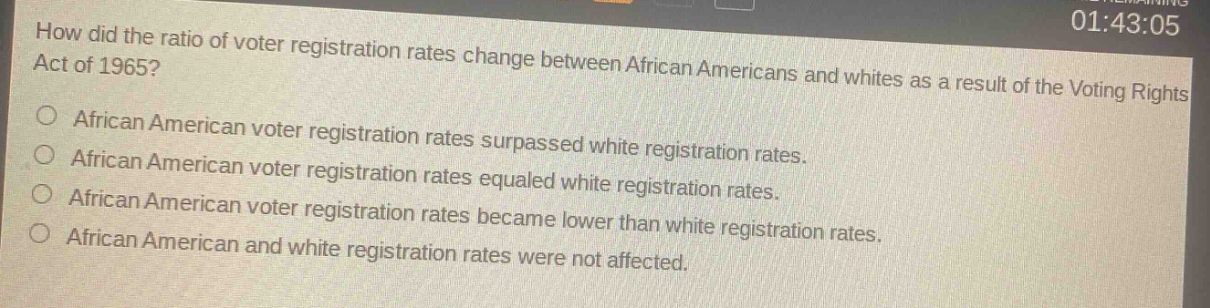
how did the ratio of voter registration rates change between african americans and whites as a result of the voting rights act of 1965?\nafrican american voter registration rates surpassed white registration rates.\nafrican american voter registration rates equaled white registration rates.\nafrican american voter registration rates became lower than white registration rates.\nafrican american and white registration rates were not affected.
Answer
Brief Explanations:
The Voting Rights Act of 1965 removed barriers that had prevented African - Americans from registering to vote. As a result, African American voter registration rates increased significantly, but they did not surpass white registration rates immediately. However, the gap between African American and white voter registration rates narrowed. Before the Act, African American registration rates were much lower. After the Act, African American voter registration rates increased and became closer to white registration rates, but did not equal or surpass them right away.
Answer:
None of the provided options are entirely accurate. But if we have to choose the most reasonable one based on the general impact, African American voter registration rates increased and the gap with white registration rates decreased, so the closest option would be that African American voter registration rates became closer to white registration rates (but this option is not present in the given choices). If we assume the closest among the given ones, none of them are correct as stated, but if we consider the trend of improvement for African American registration rates, the idea that the rates became more equal (even if not exactly equal immediately) is the most in - line with the Act's impact. So, if forced to choose, the option "African American voter registration rates equaled white registration rates" is the closest in spirit to the long - term trend of the Act's impact, though it is an overstatement of the immediate result.