read the passage.\nthe following is from an address given by mary w. dewson, a member of the social security…
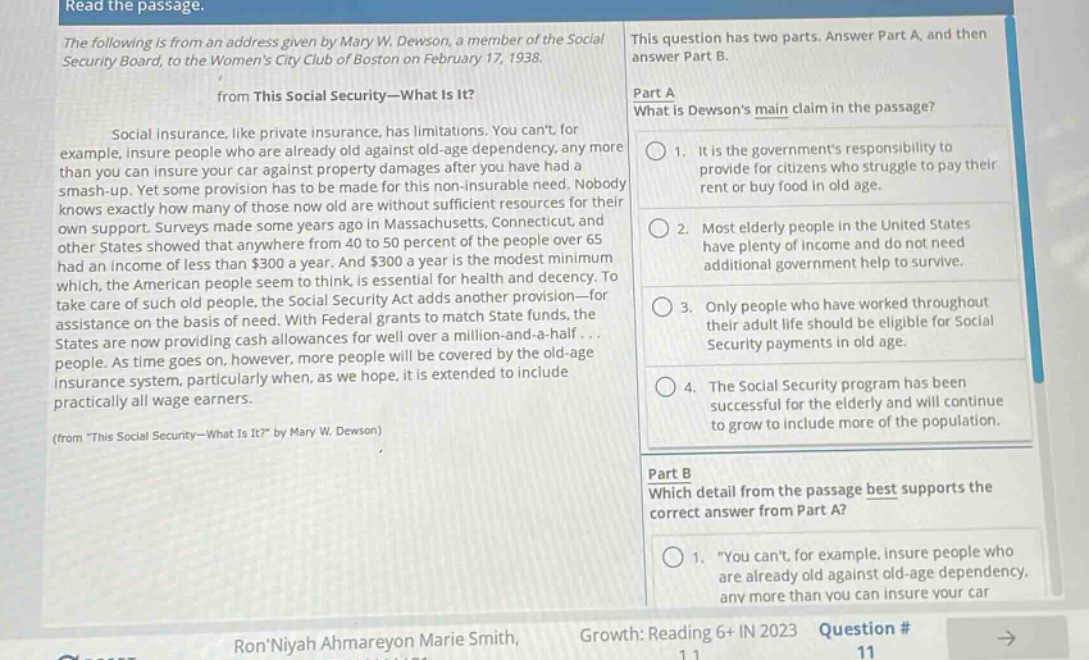
read the passage.\nthe following is from an address given by mary w. dewson, a member of the social security board, to the womens city club of boston on february 17, 1938.\nfrom this social security—what is it?\nsocial insurance, like private insurance, has limitations. you cant, for example, insure people who are already old against old - age dependency, any more than you can insure your car against property damages after you have had a smash - up. yet some provision has to be made for this non - insurable need. nobody knows exactly how many of those now old are without sufficient resources for their own support. surveys made some years ago in massachusetts, connecticut and other states showed that anywhere from 40 to 50 percent of the people over 65 had an income of less than $300 a year. and $300 a year is the modest minimum which, the american people seem to think, is essential for health and decency. to take care of such old people, the social security act adds another provision—for assistance on the basis of need. with federal grants to match state funds, the states are now providing cash allowances for well over a million - and - a - half... people. as time goes on, however, more people will be covered by the old - age insurance system, particularly when, as we hope, it is extended to include practically all wage earners.\n(from \this social security—what is it?\ by mary w. dewson)\nthis question has two parts. answer part a and then answer part b.\npart a\nwhat is dewsons main claim in the passage?\n1. it is the governments responsibility to provide for citizens who struggle to pay their rent or buy food in old age.\n2. most elderly people in the united states have plenty of income and do not need additional government help to survive.\n3. only people who have worked throughout their adult life should be eligible for social security payments in old age.\n4. the social security program has been successful for the elderly and will continue to grow to include more of the population.\npart b\nwhich detail from the passage best supports the correct answer from part a?\n1. \you cant, for example, insure people who are already old against old - age dependency, any more than you can insure your car against property damages after you have had a smash - up.\
Answer
Answer:
Part A: 4. The Social Security program has been successful for the elderly and will continue to grow to include more of the population. Part B: 1. "You can't, for example, insure people who are already old against old - age dependency, any more than you can insure your car against property damages after you have had a smash - up. Yet some provision has to be made for this non - insurable need. Nobody knows exactly how many of those now old are without sufficient resources for their own support. Surveys made some years ago in Massachusetts, Connecticut and other States showed that anywhere from 40 to 50 percent of the people over 65 had an income of less than $300 a year. And $300 a year is the modest minimum which, the American people seem to think, is essential for health and decency. To take care of such old people, the Social Security Act adds another provision—for assistance on the basis of need. With Federal grants to match State funds, the States are now providing cash allowances for well over a million - and - a - half... As time goes on, however, more people will be covered by the old - age insurance system, particularly when, as we hope, it is extended to include practically all wage earners."
Brief Explanations:
In Part A, the passage emphasizes the success of Social Security for the elderly and its growth potential. In Part B, the details about the need for Social Security due to the lack of resources among the elderly and its expansion plans support the claim in Part A.