read the passage from the opinion of the court in brown v. board of education, written by justice warren. an…
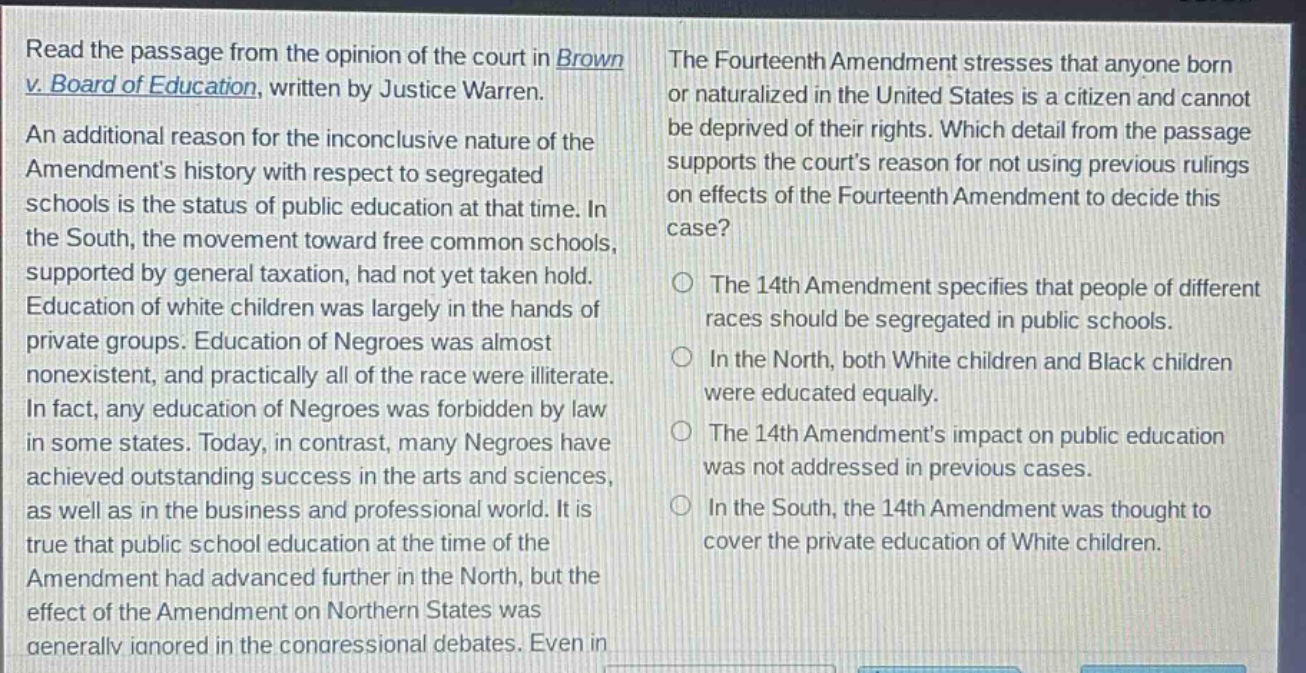
read the passage from the opinion of the court in brown v. board of education, written by justice warren. an additional reason for the inconclusive nature of the amendments history with respect to segregated schools is the status of public education at that time. in the south, the movement toward free common schools, supported by general taxation, had not yet taken hold. education of white children was largely in the hands of private groups. education of negroes was almost nonexistent, and practically all of the race were illiterate. in fact, any education of negroes was forbidden by law in some states. today, in contrast, many negroes have achieved outstanding success in the arts and sciences, as well as in the business and professional world. it is true that public school education at the time of the amendment had advanced further in the north, but the effect of the amendment on northern states was generally ignored in the congressional debates. even in the fourteenth amendment stresses that anyone born or naturalized in the united states is a citizen and cannot be deprived of their rights. which detail from the passage supports the courts reason for not using previous rulings on effects of the fourteenth amendment to decide this case? the 14th amendment specifies that people of different races should be segregated in public schools. in the north, both white children and black children were educated equally. the 14th amendments impact on public education was not addressed in previous cases. in the south, the 14th amendment was thought to cover the private education of white children.
Answer
Brief Explanations:
The passage emphasizes the inconclusive nature of the 14th Amendment's history regarding segregated schools due to the status of public - education at the time. It implies that previous cases did not address the 14th Amendment's impact on public education, which is why the court didn't rely on previous rulings.
Answer:
The 14th Amendment's impact on public education was not addressed in previous cases.