a researcher is interested in whether using mental imagery can help people remember specific details when…
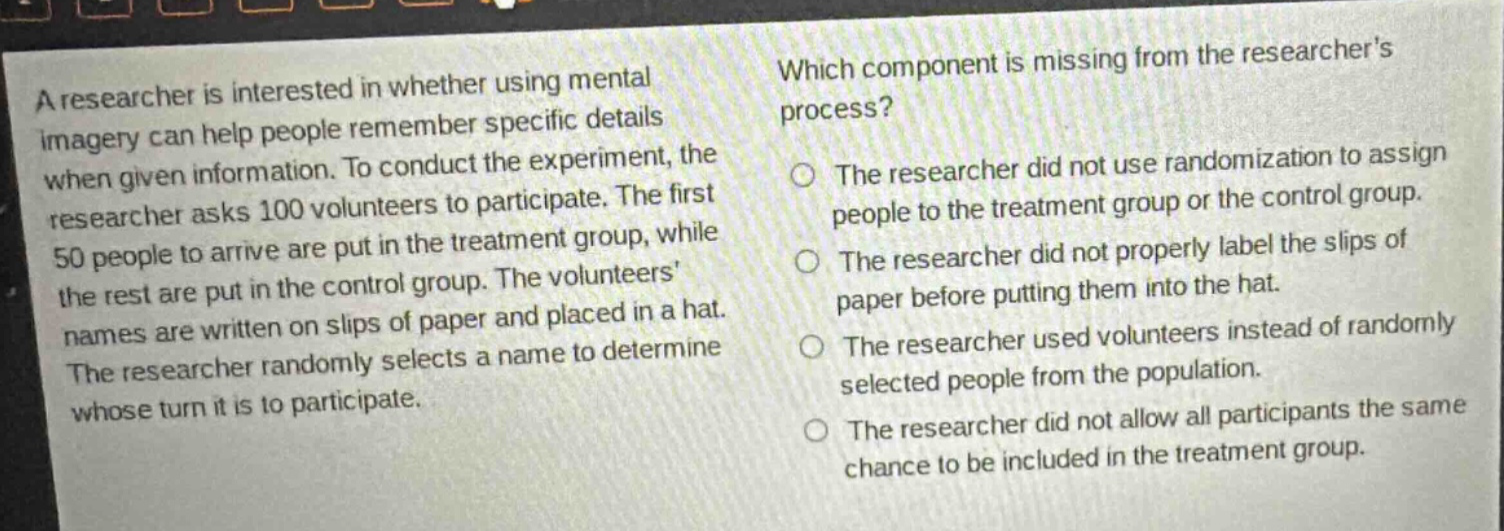
a researcher is interested in whether using mental imagery can help people remember specific details when given information. to conduct the experiment, the researcher asks 100 volunteers to participate. the first 50 people to arrive are put in the treatment group, while the rest are put in the control group. the volunteers names are written on slips of paper and placed in a hat. the researcher randomly selects a name to determine whose turn it is to participate. which component is missing from the researchers process? the researcher did not use randomization to assign people to the treatment group or the control group. the researcher did not properly label the slips of paper before putting them into the hat. the researcher used volunteers instead of randomly selected people from the population. the researcher did not allow all participants the same chance to be included in the treatment group.
Answer
Answer:
The researcher did not use randomization to assign people to the treatment group or the control group.
Explanation:
Step1: Identify the key issue
In experiments, randomization is crucial for valid results.
Step2: Analyze the researcher's method
The researcher assigned the first - 50 arrivals to the treatment group, not randomly. This non - random assignment can introduce bias as the first - arriving volunteers may have different characteristics compared to the rest, affecting the validity of the experiment's conclusion about the effect of mental imagery on memory.