to secure separate accommodations, and providing that no person shall be permitted to occupy seats in…
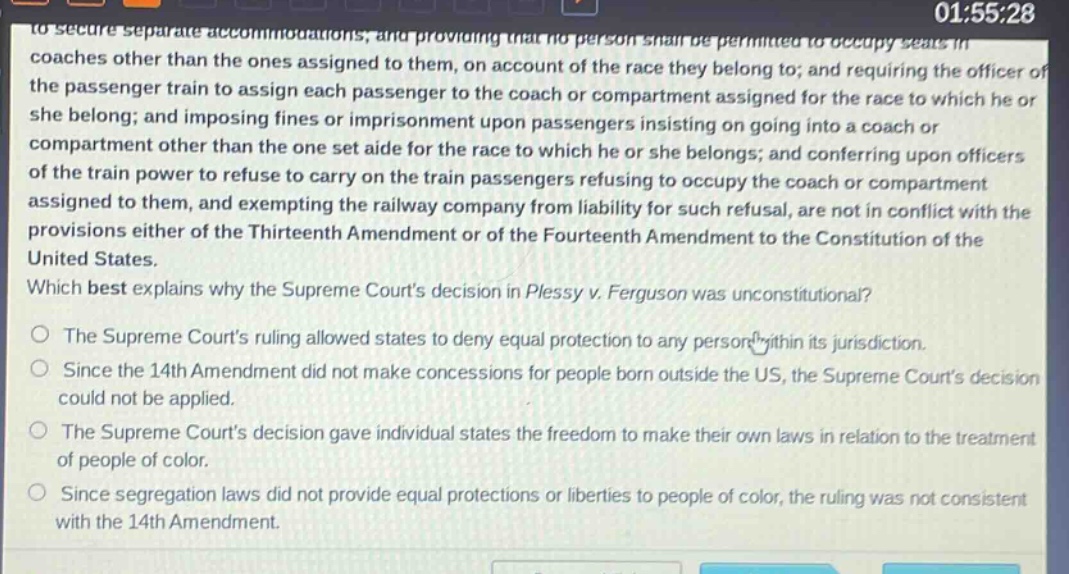
to secure separate accommodations, and providing that no person shall be permitted to occupy seats in coaches other than the ones assigned to them, on account of the race they belong to; and requiring the officer of the passenger train to assign each passenger to the coach or compartment assigned for the race to which he or she belong; and imposing fines or imprisonment upon passengers insisting on going into a coach or compartment other than the one set aide for the race to which he or she belongs; and conferring upon officers of the train power to refuse to carry on the train passengers refusing to occupy the coach or compartment assigned to them, and exempting the railway company from liability for such refusal, are not in conflict with the provisions either of the thirteenth amendment or of the fourteenth amendment to the constitution of the united states. which best explains why the supreme courts decision in plessy v. ferguson was unconstitutional? the supreme courts ruling allowed states to deny equal protection to any person within its jurisdiction. since the 14th amendment did not make concessions for people born outside the us, the supreme courts decision could not be applied. the supreme courts decision gave individual states the freedom to make their own laws in relation to the treatment of people of color. since segregation laws did not provide equal protections or liberties to people of color, the ruling was not consistent with the 14th amendment.
Answer
Answer:
D. Since segregation laws did not provide equal protections or liberties to people of color, the ruling was not consistent with the 14th Amendment.
Brief Explanations:
The 14th Amendment guarantees equal protection under the law. Segregation in Plessy v. Ferguson violated this by treating people of color unequally.