social science: this passage is adapted from the american republic: constitution, tendencies, and destiny by…
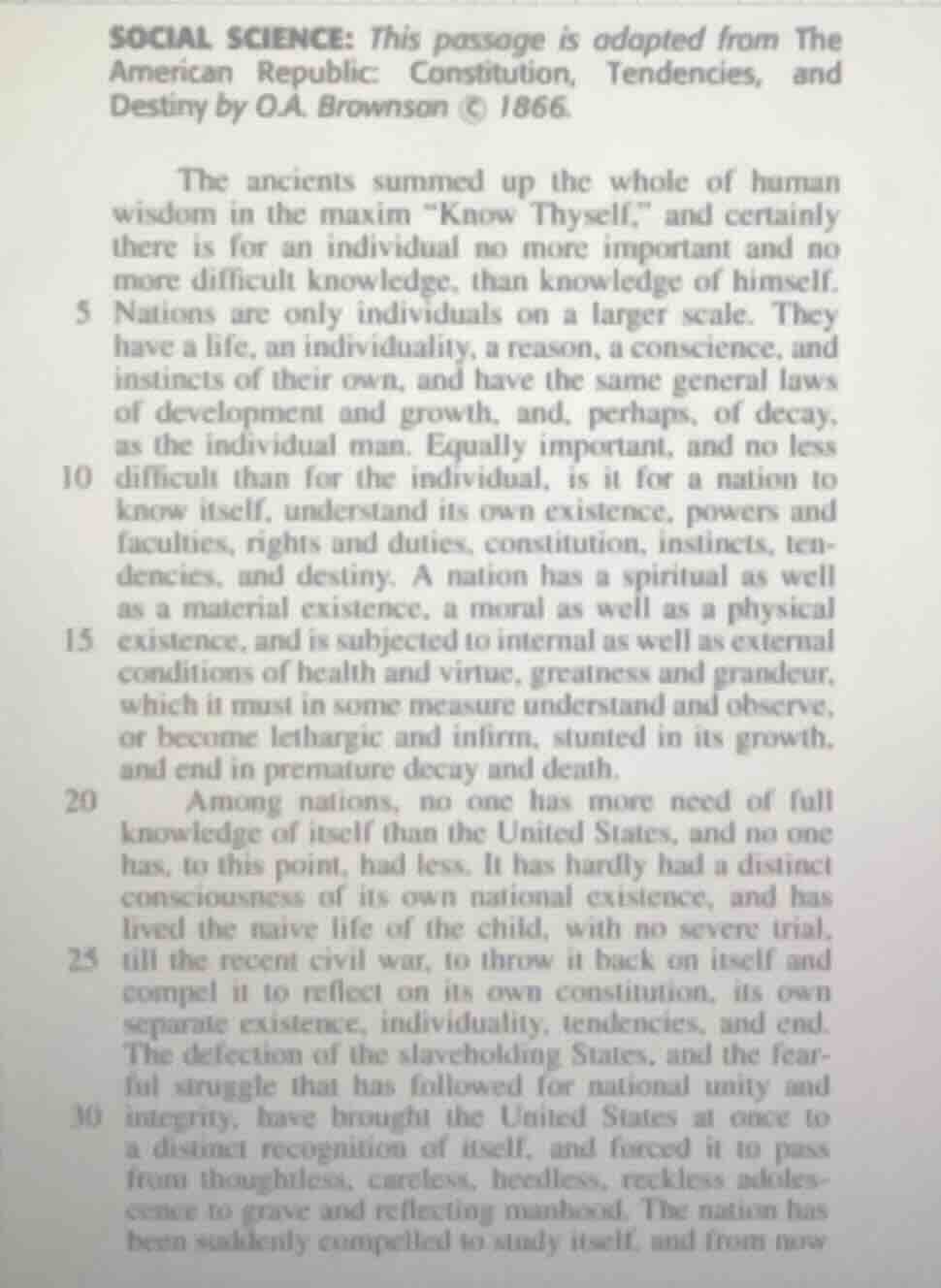
social science: this passage is adapted from the american republic: constitution, tendencies, and destiny by o.a. brownson © 1866.\n\nthe ancients summed up the whole of human wisdom in the maxim \know thyself,\ and certainly there is for an individual no more important and no more difficult knowledge, than knowledge of himself. nations are only individuals on a larger scale. they have a life, an individuality, a reason, a conscience, and instincts of their own, and have the same general laws of development and growth, and, perhaps, of decay, as the individual man. equally important, and no less difficult than for the individual, is it for a nation to know itself, understand its own existence, powers and faculties, rights and duties, constitution, instincts, tendencies, and destiny. a nation has a spiritual as well as a material existence, a moral as well as a physical existence, and is subjected to internal as well as external conditions of health and virtue, greatness and grandeur, which it must in some measure understand and observe, or become lethargic and infirm, stunted in its growth, and end in premature decay and death.\namong nations, no one has more need of full knowledge of itself than the united states, and no one has, to this point, had less. it has hardly had a distinct consciousness of its own national existence, and has lived the naive life of the child, with no severe trial, till the recent civil war, to throw it back on itself and compel it to reflect on its own constitution, its own separate existence, individuality, tendencies, and end. the defection of the slaveholding states, and the fearful struggle that has followed for national unity and integrity, have brought the united states at once to a distinct recognition of itself, and forced it to pass from thoughtless, careless, heedless, reckless adolescence to grave and reflecting manhood. the nation has been suddenly compelled to study itself, and from now
Answer
Brief Explanations:
The passage draws a direct analogy between the development of an individual and the development of a nation. The author argues that just as an individual must "know thyself" to grow, a nation must understand its own constitution, powers, and destiny. Brownson posits that the United States, prior to the Civil War, lived the "naive life of the child" without self-reflection. He identifies the "recent civil war" and the "defection of the slaveholding States" as the critical turning point—a "severe trial" that forced the nation out of a reckless adolescence and into a state of "grave and reflecting manhood," necessitating a deep study of its own national existence and integrity.
Answer:
The central argument of the passage is that nations, like individuals, must achieve self-knowledge to avoid decay, and the American Civil War served as the catalyst that forced the United States to transition from a thoughtless adolescence to a mature, self-reflective national consciousness.