which statement best explains the legal basis for the right to privacy?\nit was a new theory proposed by…
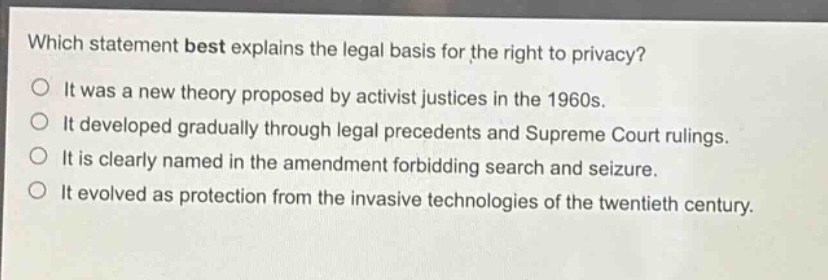
which statement best explains the legal basis for the right to privacy?\nit was a new theory proposed by activist justices in the 1960s.\nit developed gradually through legal precedents and supreme court rulings.\nit is clearly named in the amendment forbidding search and seizure.\nit evolved as protection from the invasive technologies of the twentieth century.
Answer
Brief Explanations:
The right to privacy in the United States is not explicitly stated in the Constitution. Instead, it has been established over time through a series of legal precedents and Supreme Court decisions. For example, in Griswold v. Connecticut (1965), the Supreme Court recognized a constitutional right to privacy in the context of marital relations. This decision, and others like it, built on earlier cases and interpretations of the Constitution to gradually develop the legal basis for the right to privacy.
- The first option is incorrect because the right to privacy is not a "new theory" proposed by activist justices in the 1960s. It has a longer history of development.
- The third option is incorrect because the Fourth Amendment, which forbids unreasonable search and seizure, does not explicitly name the right to privacy. While it is related to privacy interests, the right to privacy is a broader concept that has been developed through multiple legal sources.
- The fourth option is incorrect because the right to privacy is not solely a response to twentieth - century invasive technologies. It has roots in earlier legal and philosophical concepts.
Answer:
It developed gradually through legal precedents and Supreme Court rulings.