these statements are from an evaluation of john schwartz’s article. read each statement, then use the drop…
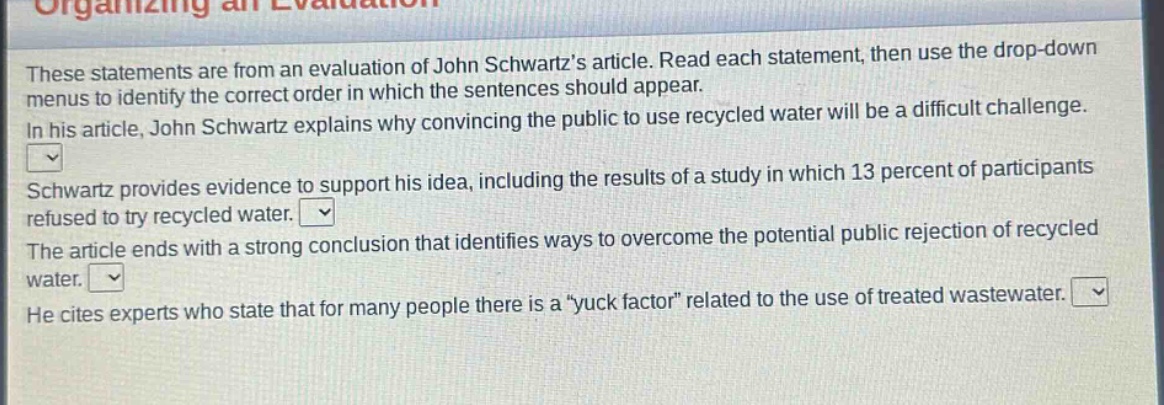
these statements are from an evaluation of john schwartz’s article. read each statement, then use the drop - down menus to identify the correct order in which the sentences should appear. in his article, john schwartz explains why convincing the public to use recycled water will be a difficult challenge. schwartz provides evidence to support his idea, including the results of a study in which 13 percent of participants refused to try recycled water. the article ends with a strong conclusion that identifies ways to overcome the potential public rejection of recycled water. he cites experts who state that for many people there is a “yuck factor” related to the use of treated wastewater.
Answer
Brief Explanations:
Typically, an article - evaluation first presents the main idea, then evidence including expert - citations, and finally the conclusion. So, the first statement presents the main idea of the article. The second and fourth statements are evidence - related. The third statement is the conclusion.
Answer:
- In his article, John Schwartz explains why convincing the public to use recycled water will be a difficult challenge.
- He cites experts who state that for many people there is a “yuck factor” related to the use of treated wastewater.
- Schwartz provides evidence to support his idea, including the results of a study in which 13 percent of participants refused to try recycled water.
- The article ends with a strong conclusion that identifies ways to overcome the potential public rejection of recycled water.