step 3: evaluate\nwhich executive system seems more effective at leading its government? (circle…
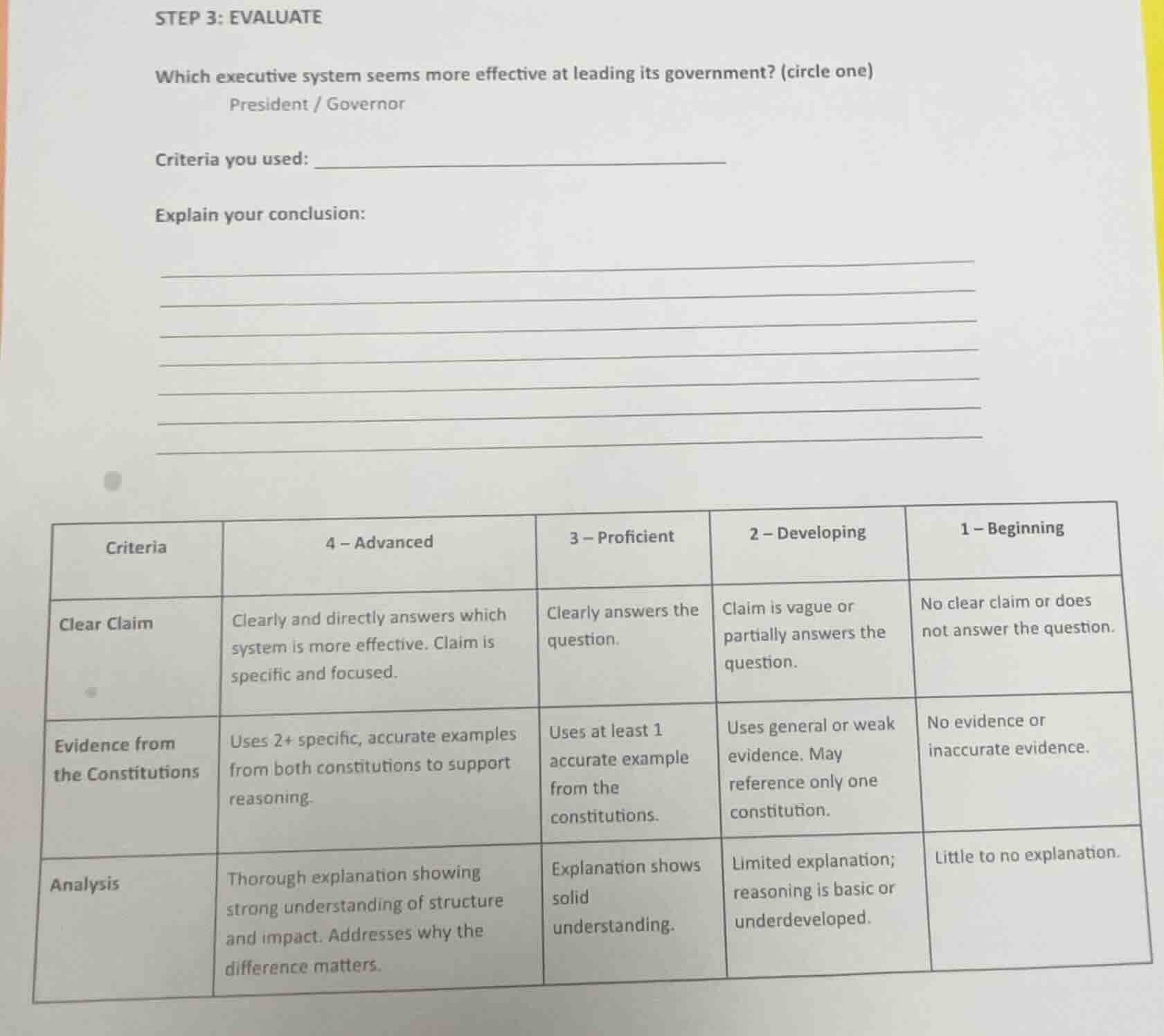
step 3: evaluate\nwhich executive system seems more effective at leading its government? (circle one)\npresident / governor\ncriteria you used: ____________\nexplain your conclusion:\n\n| criteria | 4 – advanced | 3 – proficient | 2 – developing | 1 – beginning |\n| ---- | ---- | ---- | ---- | ---- |\n| clear claim | clearly and directly answers which system is more effective. claim is specific and focused. | clearly answers the question. | claim is vague or partially answers the question. | no clear claim or does not answer the question. |\n| evidence from the constitutions | uses 2+ specific, accurate examples from both constitutions to support reasoning. | uses at least 1 accurate example from the constitutions. | uses general or weak evidence. may reference only one constitution. | no evidence or inaccurate evidence. |\n| analysis | thorough explanation showing strong understanding of structure and impact. addresses why the difference matters. | explanation shows solid understanding. | limited explanation; reasoning is basic or underdeveloped. | little to no explanation. |
Answer
Brief Explanations:
This task asks to evaluate the effectiveness of a presidential vs. gubernatorial executive system, using constitutional evidence and clear reasoning. Below is a response aligned with the "4 - Advanced" criteria:
- Clear Claim: The president is more effective at leading a national government, while a governor is more effective for state-level governance. For national leadership, the president is the stronger choice.
- Criteria Used: Executive authority scope, national-level oversight powers, ability to coordinate cross-jurisdictional action.
- Evidence & Analysis:
- Under the U.S. Constitution, the president (Article II) has the power to negotiate treaties, command the entire national military, and appoint federal judges/cabinet members with Senate consent. This allows unified national action on issues like foreign policy and interstate commerce.
- A U.S. governor (per state constitutions, e.g., California's) has authority over state agencies and state militias, but lacks the national reach of the president. For leading a national government, the president's constitutional powers enable broader, more coordinated leadership across the entire country, making their executive system more effective at the federal level.
Answer:
Which executive system seems more effective at leading its government? President Criteria you used: Scope of authority, national coordination powers, constitutional mandate for federal leadership Explain your conclusion: The presidential executive system is more effective for leading a national government. Per the U.S. Constitution (Article II), the president holds exclusive national powers: commanding the federal military, negotiating international treaties, and appointing federal officials who oversee nationwide agencies. These powers enable unified, cross-state action on issues like national security, interstate commerce, and federal law enforcement. In contrast, a governor's authority (outlined in state constitutions) is limited to their individual state, with no jurisdiction over national or interstate matters. For leading a federal government, the president's constitutional powers provide the necessary breadth and centralized authority to act on behalf of the entire country, making this system more effective at the national level.