a supreme court justice who believes strongly in judicial restraint would most likely agree with which…
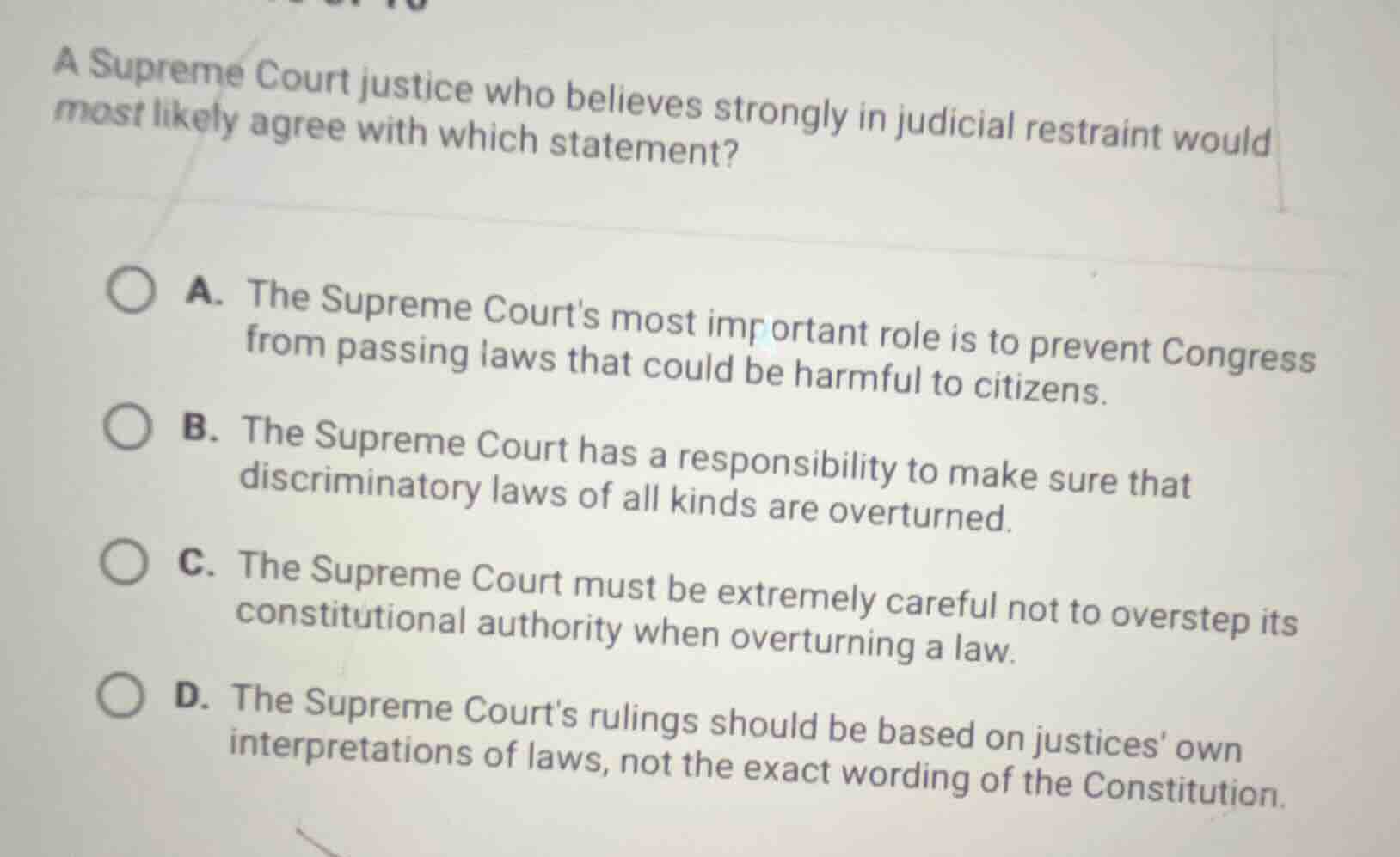
a supreme court justice who believes strongly in judicial restraint would most likely agree with which statement?\n\na. the supreme courts most important role is to prevent congress from passing laws that could be harmful to citizens.\n\nb. the supreme court has a responsibility to make sure that discriminatory laws of all kinds are overturned.\n\nc. the supreme court must be extremely careful not to overstep its constitutional authority when overturning a law.\n\nd. the supreme courts rulings should be based on justices own interpretations of laws, not the exact wording of the constitution.
Answer
Answer:
C. The Supreme Court must be extremely careful not to overstep its constitutional authority when overturning a law.
Brief Explanations:
Judicial restraint emphasizes limiting judicial power, deferring to legislative bodies, and not overstepping constitutional bounds. Option C directly aligns with this principle, as it focuses on avoiding overreach of the Court's authority. Options A, B, and D reflect more activist judicial approaches that involve broader intervention or subjective interpretation, which contradicts judicial restraint.